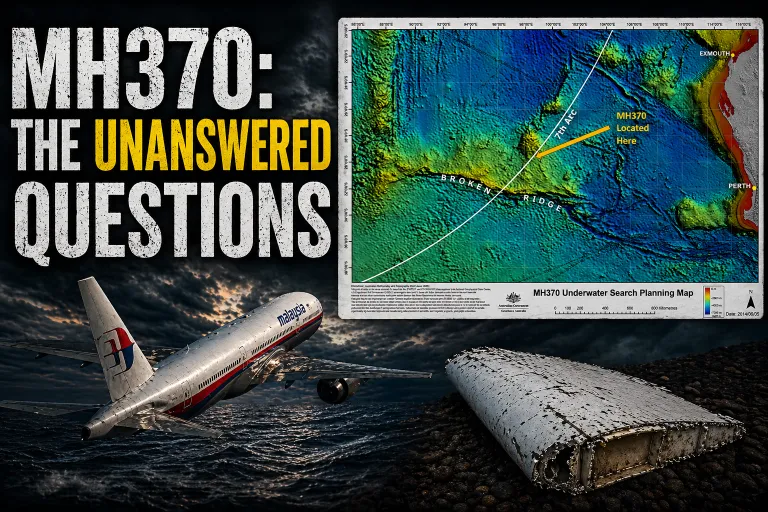
On Sunday March 8th, 2026 it would 12 years since MH370 disappeared in the Southern Indian Ocean and the question being asked would the Boeing 777 have corroded away?
The answer will surprise you.
At the depths—between 4,000 and 6,000 metres—where MH370 will lie the environment is one of the most extreme on Earth. Temperatures hover around 1–2°C, sunlight never penetrates, and hydrostatic pressure rises to 400–600 atmospheres. Yet paradoxically, these conditions slow many forms of corrosion. The deep ocean is hostile to machinery, but it is also strangely preservative.
Understanding how the Boeing 777’s materials—aluminium, titanium, steel, and carbon fibre composites—would behave at these depths provides insight into what search vehicles might find when MH370 is eventually located.
The Aluminium Airframe
The structural skeleton of a Boeing 777 is overwhelmingly made from high-strength aluminium alloys, primarily the 2xxx and 7xxx series. These alloys are chosen for their excellent strength-to-weight ratios but remain chemically vulnerable to seawater.
In deep-ocean conditions around 4,000 metres, aluminium corrosion typically progresses at roughly:
0.005–0.02 mm per year
At 6,000 metres, corrosion slows further:
0.003–0.015 mm per year
The reason is simple: corrosion requires oxygen and energy. Both are scarce in the abyss. With little oxygen and temperatures near freezing, the electrochemical reactions that eat away at aluminium slow dramatically.
This means that large components—such as wing spars, fuselage frames, and landing gear bays—could remain recognisable for decades. However, aluminium’s weakness lies in pitting corrosion. Chloride ions in seawater break down aluminium’s protective oxide film, allowing tiny pits to form. Over time these pits deepen, sometimes penetrating several millimetres.
For MH370 investigators, this means the aircraft’s aluminium skin panels may be heavily pitted, but major structural members would likely still exist even after many years.
Steel Components
Although the Boeing 777 is primarily aluminium, it contains substantial quantities of high-strength steel. Landing gear assemblies, fasteners, actuators, and numerous internal mechanisms rely on steel for durability.
In the deep ocean, typical corrosion rates for carbon steels fall in the range of:
0.02–0.05 mm per year at 4,000 metres
and
0.01–0.03 mm per year at 6,000 metres
These values are slower than corrosion in shallow coastal water but still significant over long periods.
More problematic is localized pitting corrosion, which can penetrate steel far more rapidly than uniform surface loss. Deep-sea bacteria—particularly sulphate-reducing microbes—can also accelerate corrosion by producing hydrogen sulphide, forming iron sulphides and weakening metal surfaces.
If MH370 lies in the a byssal plains west of Australia, steel landing gear structures would likely show extensive rusting and biological colonisation, but the large forged components themselves would almost certainly still exist.
Titanium
Titanium alloys are used in aircraft wherever extreme strength and corrosion resistance are required. In the 777, they appear in critical structural fittings, landing gear components, and engine parts.
Titanium’s secret lies in its oxide film—a microscopic layer of titanium dioxide (TiO₂) that forms instantly when exposed to oxygen. This film is exceptionally stable, even in aggressive seawater environments.
In deep ocean conditions Titanium corrosion rates are typically less than 0.0001 mm per year.
In practical terms, that is effectively zero over the timescale of decades.
If MH370’s engines or titanium structural fittings were located today, they would likely appear remarkably intact, aside from biological growth and sediment accumulation.
Titanium components from aircraft wrecks have been recovered from ocean depths after many decades with minimal degradation. In the case of MH370, titanium parts could survive centuries on the seafloor.
Carbon Fibre Composites
Modern aircraft incorporate increasing quantities of carbon fibre reinforced polymer (CFRP). While the 777 uses less composite material than newer aircraft like the 787, carbon fibre still appears in control surfaces, fairings, and structural components.
Carbon fibres themselves do not corrode. However, the epoxy matrix binding the fibres together can slowly absorb seawater.
Equivalent degradation rates are extremely small at <0.001 mm per year of surface deterioration
The greater risk lies not in corrosion but mechanical damage. At 6,000 metres the crushing pressure of the ocean is immense. If composite structures fractured during impact, the broken edges could slowly delaminate as seawater penetrates the epoxy matrix.
Another complication is that carbon fibre is electrically conductive. When attached to aluminium structures it can create galvanic corrosion, accelerating the decay of neighbouring metals.
The Southern Indian Ocean’s a byssal plains present a unique environment that simultaneously destroys and preserves wreckage.
Several factors slow corrosion dramatically:
Low temperature (1–2°C) reduces chemical reaction rates
Low oxygen levels limit electrochemical corrosion
Stable salinity and chemistry create predictable conditions
Low biological activity reduces microbiological corrosion
As a result, aircraft debris in the deep ocean can remain identifiable for very long periods. Pieces of aircraft lost decades ago have been recovered with structural shapes still intact.
Sedimentation may actually protect parts of the wreckage. Fine abyssal mud slowly settles over exposed structures, sometimes burying components and shielding them from seawater circulation.
When Ocean Infinity or another search operation eventually locate MH370, the wreckage field could appear surprisingly recognisable.
Large aluminium structures—wings, fuselage sections, landing gear—would likely still exist but be heavily pitted and coated with marine growth.
Steel components would show deep rust layers and corrosion pits.
Titanium parts, particularly from the engines, could appear almost unchanged.
Carbon fibre panels might remain intact but fractured or delaminated where impact forces exceeded their limits.
In the silent darkness of the abyss, the aircraft would not have vanished. Instead, it would lie slowly changing—its materials reacting millimetre by millimetre with the chemistry of the deep sea.