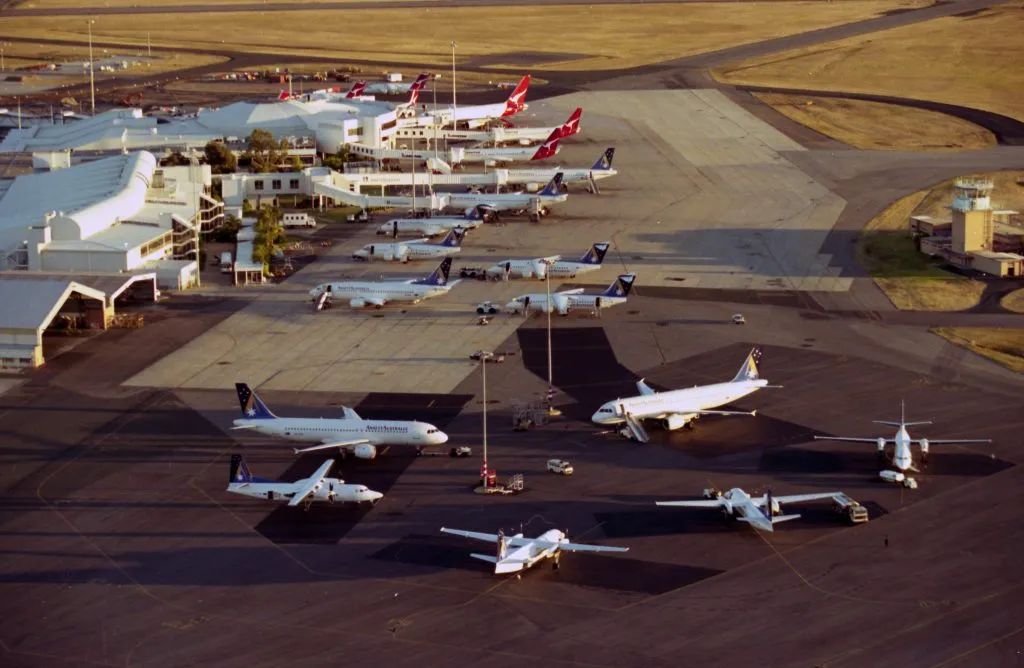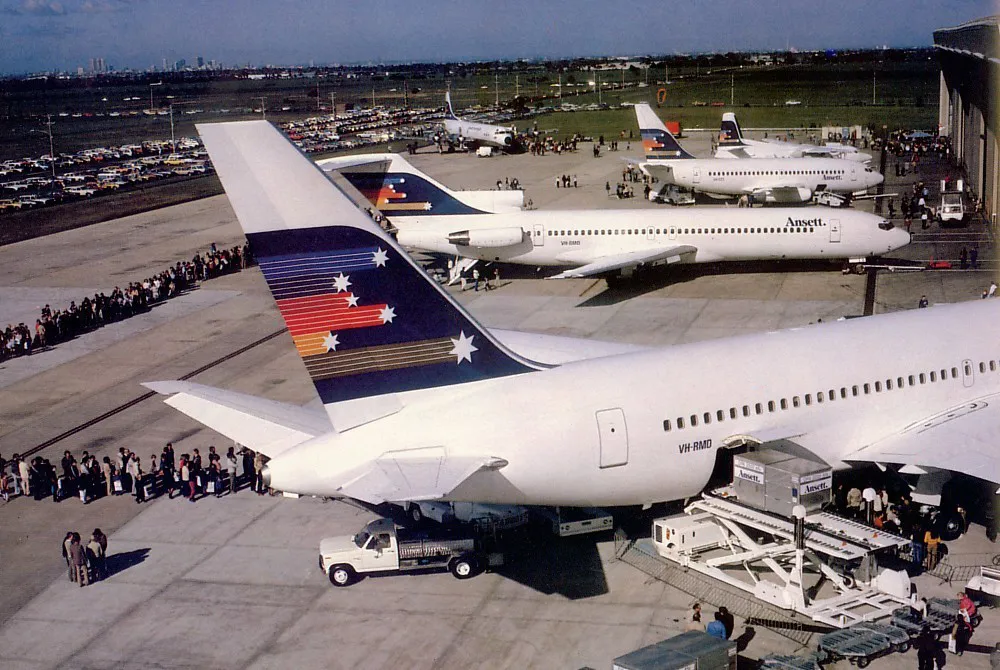
PERTH — Today, February 17, marks what would have been the 90th anniversary of Ansett Australia, once the country’s second airline whose sudden collapse in September 2001 reshaped the nation’s aviation industry.
SEE Geoffrey Thomas’s Profile.
More than two decades later, many of the structural issues that contributed to its downfall — ownership conflicts, regulatory policy, and competition strategy — continue to influence airline policy in Australia and New Zealand.
Ansett entered administration on 12 September 2001 after its parent Air New Zealand withdrew support, grounding a fleet that carried millions of passengers annually and leaving 16,000 employees without jobs.
Industry analysts at the time described the collapse as the result of strategic and governance failures rather than a single financial shock.
The airline’s demise followed years of complex ownership disputes involving Air New Zealand, Singapore Airlines and News Corporation, alongside increasing competition from low-cost entrants.
The following award-winning contemporary analysis, written by the author, shortly after the collapse, explains how those pressures converged. It was published in Air Transport World but is updated.
Recipe for Disaster
On the surface at least, the three-way tie up among Singapore Airlines, Ansett Holdings and Air New Zealand (ANZ) offered all the ingredients for a first-rate equity alliance.
SIA was and still is today (2026) one of the most profitable and best capitalized airlines in the world, with an industry-leading service image to boot. Ansett enjoyed a reputation as a top tier domestic carrier and was developing an international network.
ANZ was a small but high-quality international player hungering for growth opportunities and with a recognized skill for engineering and operational excellence. Instead, the mixture was a recipe for disaster that was food for thought in airline boardrooms and aviation ministries around the world.
Ansett, an airline with a then proud 70-year history, collapsed in the largest industrial shutdown ever in Australia. ANZ, by dint of its write offs in Ansett, has suffered the biggest corporate loss in its country’s history. ANZ was renationalized, with the NZ government taking an 83% stake in the airline that was privatized in 1989.
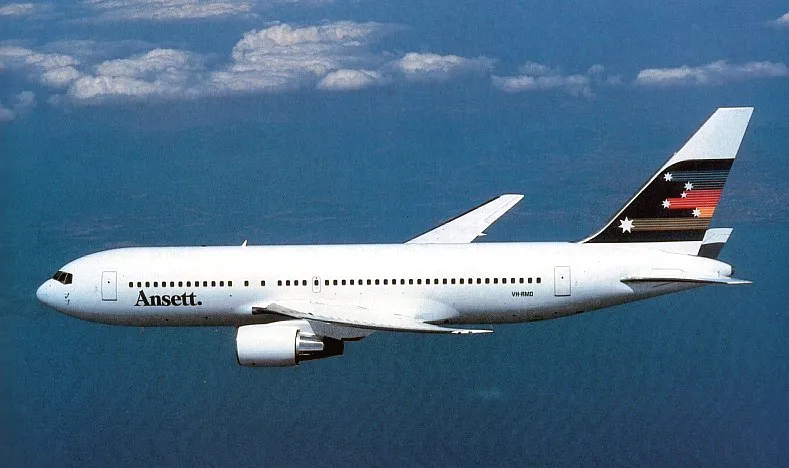
SIA’s equity alliance plans for the region were in tatters, its 25% stake in ANZ, for which it paid $170 million, was slashed to 4.3% under the bailout plan. None of those events could be blamed on the slowing of the world economy or the tragic terrorist attacks of Sept. 11, which merely accelerated the inevitable.
As the drive for globalization grew and continues to grow, airlines have been embracing cross-border equity alliances in an attempt to preserve their identities while achieving global and fiscal strength. What evolved in Australia and New Zealand was not just a local problem but a lesson for all airlines and governments and should have been seen in that light, said Peter Harbison, founder of the Sydney-based Centre for Asia Pacific Aviation.
“It is especially important that every country should recognize its ingredients, because the only way the Australia-New Zealand nightmare is different from many others is that it is the first example of an outcome that became inevitable several years ago,” said Harbison in 2001.
The story of the Singapore Airlines-ANZ-Ansett fiasco is also the story of the collision between liberalization on the one hand and the national need for a healthy and vibrant airline system on the other. Governments now must reexamine closely the fundamental role of their national airlines and measure that role against the realities of the world market.
Peter Sigley, then an airline analyst from JB Were in Auckland, suggested that governments need to revisit the issue of cross-border ownership and reassess the nature of government and foreign control of airlines. “Deregulation and liberalization cannot work when governments continue to apply regulatory conditions and then play politics,” he said.
Harbison observed that in every industry in which it is applied, deregulation ignites a remorseless trend toward consolidation and reduction of the number of competitors.
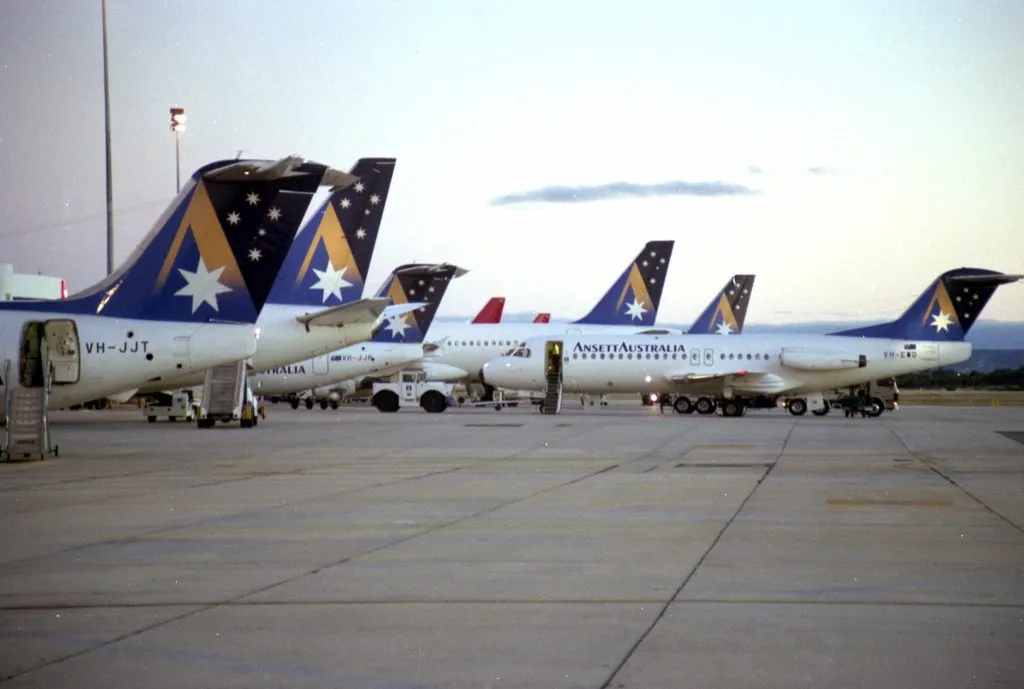
But airlines are different because of politics and nationalism. Prevented from full mergers by national citizenship requirements that underpin the bilateral system, they must embrace alliances and marketing collaboration instead.
Arguably the seeds of Ansett’s eventual demise were sown in the Australian government’s decision in the early 1990s to merge its two state-owned airlines, wholly domestic Australian and wholly international Qantas.
Overnight, Qantas, which had not been permitted to fly within Australia, gained a fully developed domestic system. Ansett, on the other hand, was forced to build its own international system from scratch, a handicap it never overcame.
However, the immediate event that set Ansett on the road to extinction occurred in 1996 when its 50% owner, Thomas National Transport, decided to quit the airline business and ANZ jumped in to take up the TNT holding.
ANZ saw this as an opportunity finally to gain a foothold in the Australian domestic market it considered vital to its future growth given that the Australian government had reneged on an agreement to create a single transtasman aviation market.
Initially at least ANZ appeared to make all the right moves. Cathay Pacific MD Rod Eddington was recruited by News Corp. to run Ansett. Several months later he gave a candid but prophetic opinion of the carrier: “Great airline, lousy business.”

By 1996 Ansett was certainly a lousy business laden down with excess baggage, a legacy of the 1980s when its then chairman, the late Peter Abeles, thought deregulation was a new brand of champagne. He saddled Ansett with 37 companies—many, such as one that made golf carts and another lecterns, totally unrelated to aviation— while neglecting the airline itself.
Meanwhile, Rupert Murdoch’s News Corp., which owned the remaining 50% of Ansett, was far more involved in developing its media and broadcasting businesses in the US and elsewhere. Thus the airline was a neglected stepchild just at the point when it most needed parental attention.
Eddington immediately saw that Ansett’s fleet needed a shot in the arm and placed options for seven 767-300s. But 50% owner ANZ balked at the commitment—in large part, according to analysts, because its own controlling shareholder, Brierley Investments, also was having financial problems.
Brierley was an asset-trading company that had participated in the privatization of ANZ in 1989 but that had no other connection to the airline industry. Other issues surfaced as well.
Eddington and ANZ CEO Jim McCrea wanted to integrate the two airlines. But their staffs didn’t, and the cultural collision was not simply a matter of industrial rivals battling for the upper hand in the corporate equivalent of an arranged marriage.
At the heart of the dispute was the problematic relationship between Australia and New Zealand. While both share a common heritage, there is a deep mistrust between them. “The only people New Zealanders hate more than foreigners are Australians,” quipped one Auckland-based analyst.
The cultural clash quickly came to the fore as the two CEOs strove for operational and marketing efficiencies. For example, ANZ blocked Eddington’s push for Ansett International to replace ANZ on the Sydney-Los Angeles route despite the fact that Ansett passengers were shunning ANZ for Qantas.
The two airlines even argued over whose name would head the new Star Alliance lounge at Sydney Airport. Those problems meant that planned cost savings from synergies were way behind. Despite these problems, within two years Eddington had Ansett in profit and in an alliance with SIA, an early member of Star.
And against the odds, Ansett also was developing an international presence. Now, however, a new challenge arose. News Corp. was eager to follow TNT out of the airline business and put its 50% stake on the block. As a condition of its agreeing to buy out TNT, ANZ had received a right of first refusal on the News Corp. stake.
Eddington believed that ANZ did not have the balance-sheet strength to buy Ansett and so approached SIA, which twice before had tried to secure stakes in Australian airlines— Ansett in 1991 and Qantas in 1994. It is unclear whether SIA was aware of the deep cultural mistrust between ANZ and Ansett when it entered the scene.
SIA sought advice from its banker ABN-Amro on ANZ’s ability to exercise the preemptive right to News Corp.’s holding. The advice was the same as Eddington’s—ANZ would never attempt to buy the shares. So SIA made its bold play for 50% of Ansett in early 1999 and Eddington agreed to stay on for another two years . Then SIA CEO Cheong Choong Kong was delighted: He had Australian government approval and he had access to Ansett International, which had enormous growth prospects. “It is the jewel in the Ansett crown,” he said at the time.
Backed by SIA’s enormous resources, Ansett International could expand quickly to rival Qantas. But he didn’t take into account the fact that Brierley had grown tired of its investment in ANZ, which now stood at 57%, and was looking for a way out.
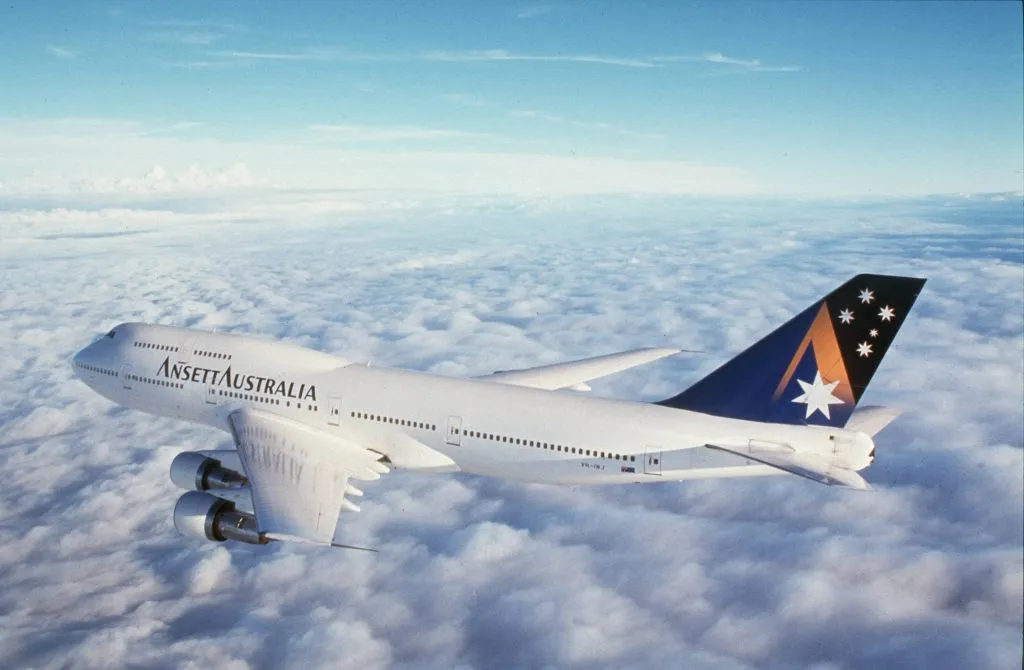
He also ignored another key ingredient: New Zealand’s fierce national pride. “The kiwis thought SIA and Ansett were conspiring to cut them out,” says one Ansett executive at the time. Brierley controlled the ANZ board and was eager to bring SIA into that airline and reduce its stake at the same time.
So ANZ, against Eddington’s own prediction, made a bid for the remaining 50% of Ansett, blocking SIA. The Australian Foreign Investment Review Board could have deemed the deal not in the national interest. After all, Brierley was known to be having financial difficulties, having taken massive writeoffs.
SIA clearly was the bettercapitalized investor. Additionally, although it controlled ANZ, Brierley itself now was controlled by Malaysian interests. The company, while founded in New Zealand, was domiciled in Singapore and registered in Bermuda.
But the Australian government did nothing. Thus the outcome was much as Brierley wanted. ANZ took News Corp.’s share in Ansett and SIA was forced to pursue a back door by taking a large slab of Brierley’s stake in ANZ.
Arguably, the outcome satisfied no one. SIA ended up in partnership with the company that had blocked its bid for Ansett. Because of the bidding war with SIA, ANZ paid top dollar for Ansett at a time when the carrier was in need of significant new investment and right at the point when two cut-price new entrants, Virgin Blue and Impulse, were set to challenge the domestic duopoly.
“It defies belief that they didn’t know what they were buying,” said Jeanette Ward, then an airline analyst at global ratings agency Standard & Poor’s. Problems began almost immediately. Eddington left for British Airways, McCrea was dumped along with 13 Ansett executives and S&P downgraded its rating on ANZ.
It was to downgrade it three more times in the next year. With McCrea’s departure, ANZ Chairman Selwyn Cushing, a small-town accountant and mate of Brierley founder Ron Brierley, took up the CEO position.
Bill Forrest, former legal adviser to Ansett, summed up that situation in the highly respected Australian Financial Review: “ Cushing did not have the first clue on how to run an airline.”
While the management upheavals were rocking Ansett and ANZ, Richard Branson’s Virgin Blue and Impulse Airlines started flights with a cost structure half that of Ansett.
And here was yet another error, said Greg Ward, then an airline analyst with Credit Suisse First Boston in Melbourne: “The Australian government allowed a foreign-owned airline to fly on Australia’s domestic routes when [it] knew the incumbents were not ready.” After all, Ansett barely had survived its encounter with the late Bryan Grey’s low-fare startup Compass Airlines in 1991. “We were just a few weeks away from going bankrupt ourselves when Compass fell over,” claimed the late Peter Young a former Ansett executive.
Despite that narrow escape, Australia’s trade unions were not flexible on productivity tradeoffs that might have made Ansett more competitive. A decade later it was just as vulnerable. As Virgin Blue and Impulse were tearing at the heart of Ansett in the second half of 2000, it would have been logical to assume that ANZ would seek to safeguard its enormous investment.
Ansett’s costs were AUD 0.16 a seat km, Qantas’s were AUD 0.12 while Virgin’s were AUD 0.08. Qantas however controlled the business market.
But ANZ had its own problems: Brierley was unwilling and unable to provide any funding and SIA, having been outmaneuvered by Brierley once already, was not going to sign any blank checks. If it was to be the banker it wanted a bigger share in ANZ and even its own piece of Ansett.
But it ran into another roadblock: Under NZ law, SIA as a foreign airline was limited to holding no more than 25% of ANZ. Initial efforts to involve the NZ government fell afoul of local politics. The left-wing coalition government of Prime Minister Helen Clark was not eager to take up the issue, particularly given that Cushing was the major fundraiser for the main opposition party. “She wasn’t going to be doing Brierley any favors,” said one observer. “Brierley and Cushing represented everything that Clark hated about big business,” said another.
It was also clear that the government did not recognized the severity of the growing crisis, which hit with the force of a tsunami. In November 2000 the Australian media broke the news that Ansett was losing a lot of money and forced ANZ to concede that fact to the stock exchange.
The next month Cushing finally appointed a professional manager, former Qantas Deputy CEO Gary Toomey, to run the combined ANZ-Ansett group. By now, however, Ansett was nearing its endgame. A series of operational and maintenance breakdowns beginning over the Christmas holiday that led to the forced grounding of nine 767s severely damaged public confidence.
Toomey hit the ground running in January 2001; his first task was to shore up Ansett’s few remaining significant corporate accounts, which were about to walk to Qantas.

Just three months later the 767s were grounded again over yet another service bulletin oversight. The Australian safety regulator kept them down for weeks as reports from Ansett’s pilots, which were made public, told of an airline in disarray.
In May Impulse Airlines, which was losing US$500,000 a week, collapsed into the arms of a very willing Qantas, while SIA made yet another bid to get the NZ government to embrace a lift in its ANZ ownership to no avail.
Then Qantas entered the battle, making a bold bid for SIA’s stake in ANZ with Ansett to be sold off to the Singapore-based carrier. Its motivation was to create two equal blocks, Qantas/ANZ and SIA/Ansett. By now, however, SIA was not as eager to take a piece of Ansett.
Instead it again offered to increase its stake in ANZ and underwrite additional capital raising so the parent could fund badly needed aircraft for Ansett. By June Ansett was hemorrhaging US$9 million a week, its yield had dropped 16% and a loss of US$200 million for the year to June 30 was tipped.
With Qantas now negotiating directly with the ANZ board and Brierley, Cushing stepped down because of the conflict of interest and the board, under Acting Chairman Jim Farmer, endorsed the SIA proposal, covered by an MOU and subject to due diligence on Ansett’s health.
What now unfolded was months of procrastination and back-room dealing as the Australian government pushed the Qantas line and a divided NZ government didn’t know quite what to do. The ANZ board also was deeply divided and all this time the airline’s shares were being devastated by almost daily changes in direction by government ministers.
Not surprisingly to many, ANZ-Ansett management’s entire recovery strategy for Ansett was based on buying out Virgin Blue and eliminating the low-fare competitor. Branson apparently signed an MOU on the deal but then had a change of heart as positive profit numbers came in on his fledgling operation and the severity of Ansett’s problems became clear.
Ironically, Branson (below) previously had sold 49% of his flagship airline, Virgin Atlantic, to SIA. Within hours of Branson’s rejecting the ANZ offer by publicly tearing up a simulated check for US$125 million, Farmer had Ansett up for sale to Qantas for just AUD$1!
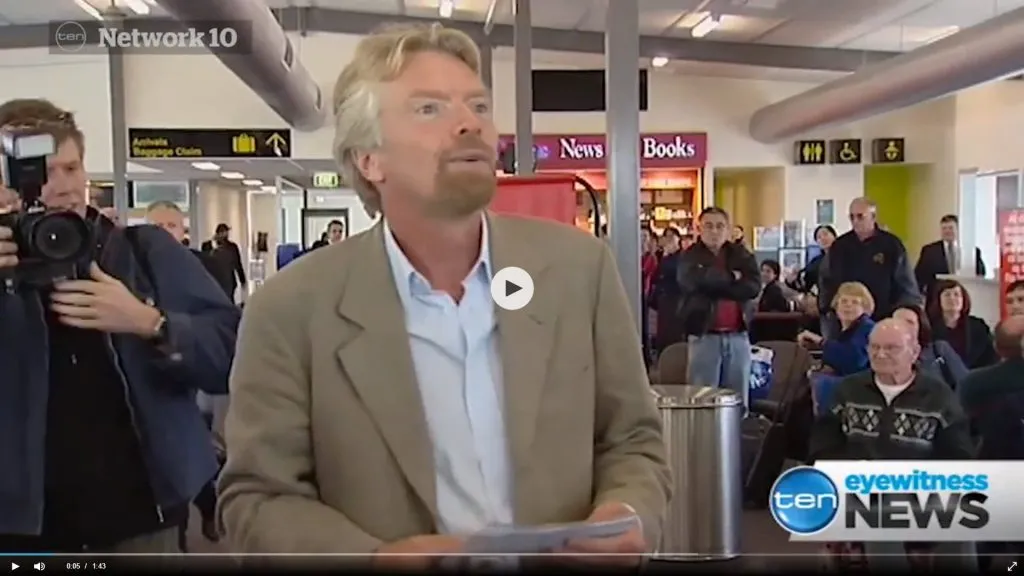

But with Virgin Blue staying in the market, Ansett was finished and bankrupt. SIA already had rejected the same offer and a week earlier had backed off the recapitalization of ANZ, fearing it would be dragged down as ANZ had to face writing off its Ansett stake.
The outcome was savage and swift. On Sept. 12 ANZ abandoned Ansett and its 16,000 staff and placed the airline in administration and announced a US$340 million recapitalization plan to restore some health to its ravaged balance sheet.
Two days later Ansett was grounded. The shutdown was a disaster for Australia as a host of regional centers were cut off and tourism devastated. The country now is left with one megacarrier and a tiny low-fare airline.
The NZ government, at last awake to the problems faced by ANZ, on October 4 agreed to inject US$362 million and renationalize the carrier. Toomey resigned a few days later.
Analysts, commentators and some politicians in both countries called for a total policy rethink that recognized the special political, economic, strategic and social needs that have become attached to a national airline.

On the 10th anniversary of the demise of Ansett, former employees Fran O’Dwyer, Gaye Dickinson, Jo Treacy and Harry Van Wees reunited to reminisce. Geoffrey Thomas
“It’s time to recognize that this is a failure of government strategy and one with potentially deep economic and social implications,” said Harbison at the time. Ward agreed: “For a country the size of Australia particularly, the need for a workably competitive domestic airline system is overpowering,” he warned. “It provides a fundamental social and communications role. It is also the basis of tourism and business evolution.”
Harbison said Australia and New Zealand no longer can hide behind concepts like competition policy or privatization policy or deregulation policy. “These are policies which are projected to deliver a particular outcome. Patently, in the aviation industry they do not and will not deliver the sort of outcome which is or will be acceptable to many governments,” he said.
Harbison also pointed out that airlines are not attractive investments and unless they are big or have a unique market position, the risk profile is becoming increasingly difficult.
“Investors don’t like risk, which has a lot to do with why airlines are constantly the beggars of the stock market,” he said. By far the most enthusiastic investors in airlines are either governments or other airlines because they have ulterior motives such as synergies or nonfinancial returns.
What Australia and New Zealand and many other similar-sized countries need to address in a bipartisan way is precisely what it is they want from their airline industries. “And then establish a clear strategy to achieve it,” said Sigley.
Harbison added, “If that strategy involves removing national ownership controls, the fact should be recognized, and if it involves exemptions from competition laws relating to mergers, then legislation should be changed.” But any rethink will come far too late to save Ansett, which stands as a poster child for everything that can go wrong as governments and industry strive to reposition themselves for a global economy.
Fast forward to 2026, since the demise of Ansett, many other airlines have collapsed such as; OzJet, Air Australia, Tigerair Australia, Bonza, Virgin Australia during COVID, REX jet network, MacAir, SkyAirWorld and REX regional airlines.