
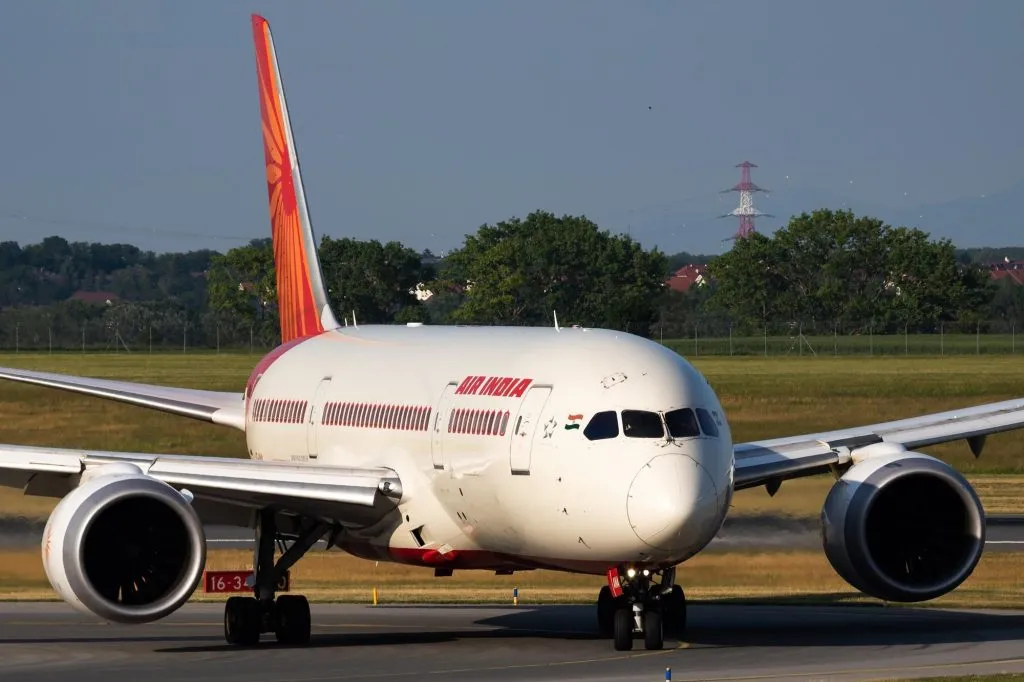
Here we provide a series of answers to the most common questions we are asked on the loss of Air India Flight AI171.
ANA Flight 985
Please see Episode 134 on 2nd July 2025:
“In the case of ANA flight 985 on 17th January 2019 at Osaka Airport, after landing, during rollout
with thrust reversers deployed, both Rolls‑Royce Trent 1000 engines shut down simultaneously,
which is a rare dual flame-out event.
The aircraft coasted for about 2,450 m (8,000 feet) before stopping safely, no injuries or fire
occurred. The aircraft was towed off the runway.
We have talked about the Jetstar Boeing 787‑8 flight from Cairns to Osaka (March 2019), an
uncommanded thrust rollbacks to below idle, first the left, then the right engine.
The left engine’s RPM dropped below idle for approximately 8 seconds, triggering an “ENG
FAIL L” alert. A minute later, the right engine fell below idle for about 81 seconds, setting off an
“ENG FAIL R” message.
The crew disconnected the right-hand auto-throttle and manually set the lever to idle as per
procedures. This happened at an altitude of around 16,000 feet and the aircraft landed safely.
In the Air India case the insufficient thrust happened at a low air speed and a low altitude. There is
little time for the pilots to be able to handle the situation.”
Boeing FCOM Extract On Engine Restart
Primary Engine Indications.
Turbofan Power Ratio (TPR).
Low Pressure Rotor Speed (N1).
Exhaust Gas Temperature (EGT).
Secondary Engine Indications (in CUTOFF, or N2 below idle).
High Pressure Rotor Speed (N2).
Fuel Flow (FF).
Engine Vibration.
In-flight Start.
Start envelope displayed on EICAS when an engine is not running (N2 below idle), or is shut down
and fire switch is not pulled.
Indicates airspeed range to ensure in-flight start at current level. If above maximum start altitude,
maximum start altitude and airspeed range are displayed.
Secondary engine indications are displayed in flight when an engine is not running (N2 below idle
with FUEL CONTROL in RUN) or FUEL CONTROL is moved to CUTOFF.
Starter assist indication (X-START) is displayed below N2 when current altitude and/or airspeed
are outside the windmilling start envelope.
Autostart makes continuous start attempts until engine either starts or pilot aborts the attempt
(FUEL CONTROL to CUTOFF, and START to NORM if starter assisted).
During windmilling start, EEC monitors engine parameters to provide best fuel schedule to ensure
shortest start time.
Engine Ignition.
Each engine has two igniters. EEC selects appropriate igniter(s) for successive ground starts.
Dual igniters always used for in-flight starts. Aircraft DC power is the normal power source, with
standby power as a backup source.
Auto-Relight.
Protection for flameout and sub-idle stall recovery.
No manual or automatic continuous ignition.
Activated whenever a flameout is detected, or engine is at or below idle with FUEL CONTROL in
RUN.
EEC commands both igniters on, and switches them off when at idle again. Also provides
protection against flameout during periods of excessive rain/hail ingestion.
Note:
For in-flight starts, the system discontinues the start by cutting fuel if takeoff EGT redline limit is
reached, no light-off or hung start.
Windmill motors the engine for 30sec before making another attempt.
Starters are re-engaged.
Autostart takes corrective action if start problems are detected, but does not abort it.
During second or subsequent attempts, autostart re-introduces fuel and ignition when EGT
<200°C.
British Airways 787 Fleet
787‑8 – 12 active (2 of 14 are inactive).
787‑9 18 active (1 of 19 is inactive).
787‑10 11 active (1 of 12 inactive).
International Airlines Group (IAG), BA’s parent company, has ordered 32 Boeing787‑10s,
scheduled for delivery between 2028 and 2033.
Additionally, BA holds options for up to 10 more Boeing787s, likely 787‑10s.
ECIAS Messages on Engine Fail and Shutdown
ENG FAIL L.
ENG FAIL R.
ENG FAIL – CHECK ENG (Checklist prompt).
ELEC GEN OFF L / R.
ENG SHUTDOWN L / R.
GEN OFF BUS L / R.
HYD PRESS ENG L / R.
FUEL PRESS ENG L / R.
ENG EEC MODE L / R.
RAT DEPLOYED
Engine Shutdown and RAT Deployment
The sequence is:
1. Dual Engine Shutdown >
2. Dual IDG Shutdown >
3. Dual AC Bus Failure and Hydraulic Failure >
4. RAT Deployment >
5. Main Battery Backup >
6. RAT Hydraulic On-Line >
7. Electrical Power On-line
In time sequence (minimum elapsed time from 1.) 1. @ 0s > 2. @ 3s > 3. @ 3s > 4. @
3.87s > 5. @ 3.87s > 6. @ ≈9.87s > 7. @ ≈13.87s.
FADEC Function
The Engines can be shutdown by the pilots or automatically by the aircraft system called the
FADEC.
The FADEC is the Full Authority Digital Engine Control and is an Engine Electronic Control
system.
The FADEC system is continuously monitoring the health of both Engines. The FADEC is a
protection system and only acts to shutdown an Engine, when one of the following conditions
occur:
- Uncontained Engine Failure or Major Engine Damage.
- Multiple Fire Detection Signals with Failed Fire Suppression.
- Severe Internal Oil System Failures.
- Over Temperature Events.
- Fan or LP/HP Compressor Stall With Surge and Restart Failure.
- Turbine Overspeed.
- Loss of FADEC Redundancy or Total Control Loss.
In the case of the Air India flight 171 crash, the FADEC was able to successfully relight both
Engines after the Engines were shutdown, but unfortunately the thrust was not sufficient in a
timely manner to allow the aircraft to gain altitude and start to climb again, after the descent from
the initial climb had commenced.
Fuel Switch Position Monitoring
The FDR records the fuel switches position RUN or CUTOFF.
The schematic/wiring diagram of the switch that shows the switch energises a relay from
the 28 Volt DC circuit.
These switches are monitored via the aircraft’s avionics data bus.
The switch position (RUN or CUTOFF) is captured and timestamped in the data stream
sent to the FDR.
The switch energises a relay powered from the 28V DC power supply. The switch
completes a voltage circuit when moved to RUN, signalling to the FADEC to open the
valve. If that voltage is lost—whether by switch being moved to CUTOFF or loss of power
—the relay de‑energises and FADEC closes the fuel valve, which the FDR registers as
CUTOFF.
Manual Fuel Switch Operation.
The RUN/CUTOFF switches themselves are not motorised and cannot be physically moved
automatically by the avionics, FADEC, or any thrust management system.
They are manually operated switches.
The Electronic Engine Control (EEC) or FADEC can independently shut off fuel flow to the engine
under certain conditions, without requiring the physical movement of the RUN/CUTOFF switch.
This includes:
i. Fire handle pulled: This overrides the switch and closes fuel shutoff valves.
Ii. Engine overspeed, severe damage, or failure conditions: The EEC can shut down the engine
autonomously.
Iii. Automatic relight logic (if an engine fails): If automatic relight is unsuccessful, the EEC may
stop trying to supply fuel.
The fuel switches were cycled due to pilot confusion or misinterpretation of the situation.
In the event of a dual engine flameout, Boeing’s standard procedure is:
- Leave fuel switches in RUN.
- Let the FADEC attempt an automatic relight, via windmill or starter assist.
- Monitor engine indications and avoid cycling switches unless specifically instructed.
There is no QRH or FCOM procedure that tells the crew to move both fuel switches to CUTOFF to
“help” with relight.
Take-Off Air Speed.
08:08:33 V1 IAS 153 knots
08:08:35 Vr IAS 155 knots
Timing: A 2-second gap between V1 and Vr is typical, especially for a large aircraft like the Boeing
787.
Speed Difference: A 2-knot difference between V1 and Vr is also within normal parameters. Vr is
generally just a few knots above V1 for a balanced field takeoff.
Crew Action: Once V1 is called, the takeoff is committed. The rotation call at Vr shows the pilot
began pulling back on the control column to achieve liftoff.
Configuration: Flaps 5, TOGA, TOW ≈ 195,310 kg
Ambient conditions: ~38.9°C, QNH 1001.1 hPa (≈ 2442 ft PA), dry 3,505 m runway
Given:
Vr = 155 knots at 08:08:35
Assume pitch rate of ~3° per second, requiring ~2–3 seconds to reach ~10°–12° pitch
Airspeed gain during rotation (acceleration continues) likely ~2–3 knots/sec at this weight and
thrust
Then:
VLOF ≈ 157–160 knots IAS
Most probable VLOF = 158 knots IAS, at approximately 08:08:37–08:08:38.
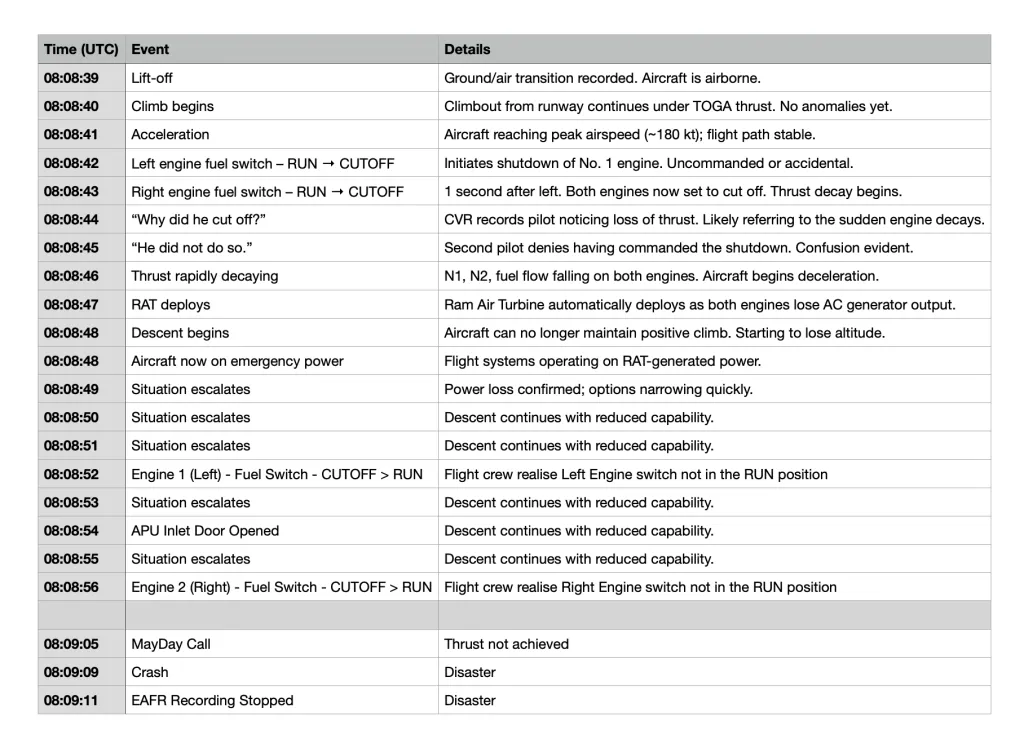
08:08:42 Maximum Air Speed 180 knots
WoW Sensors.
There are 6 WoW sensors, 2 on each wheel, 5 out of 6 or 4 out of 6 will still indicate an Air Mode
Transition.
The Preliminary Report clearly states that the Air Mode Transition was signalled at 08:08:39 UTC.
Timeline
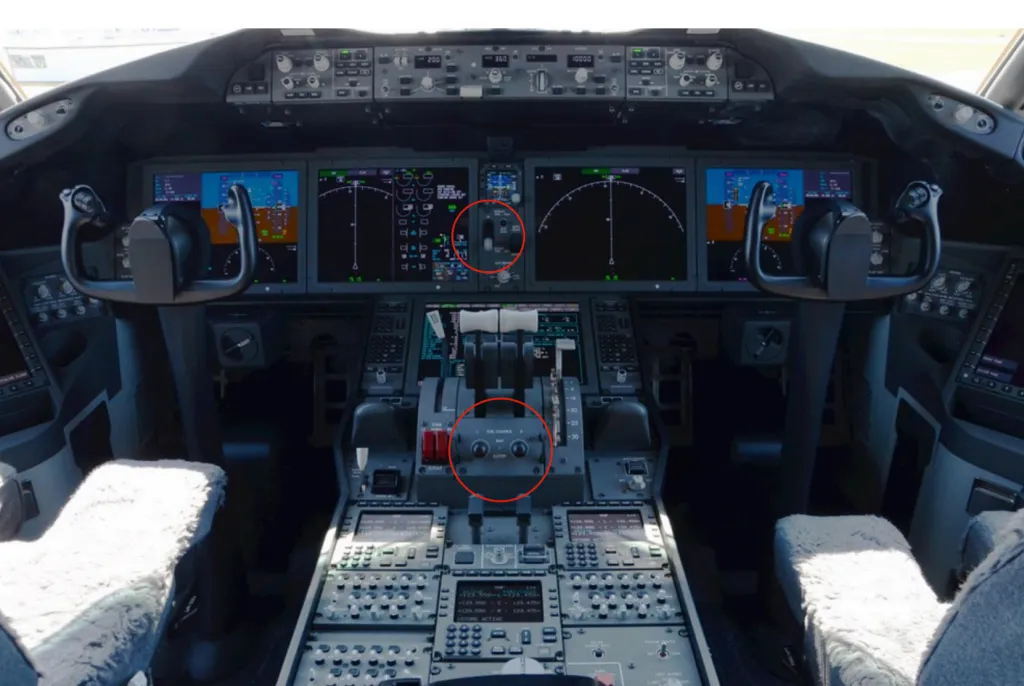
Proximity Fuel Switches and Gear Lever
Fuel switches are below but in line with the gear lever.
Aircraft Weight and Balance
On the Boeing 787-8, the Weight and Balance System (WBS) uses inputs from nose landing gear (NLG) strut sensors to determine aircraft weight and centre of gravity (CG).
This information is continuously compared with pilot-entered data in the Flight Management Computer (FMC) via the Flight Management System (FMS).
If there is a significant mismatch between the sensed weight/CG and the pilot-entered weight/CG, the system alerts the flight crew.
The EICAS Caution message FMC WEIGHT DISAGREE will be shown in the cockpit and the Pilot is then expected to double check the FMC Weight Entry and cross check with the Load Sheet and Performance data.
The trim setting and V1, Vr and V2 speed calculations may need to be recalculated.
Dust Cloud Creation
The runway at Ahmedabad Airport is 45 m wide.
The distance on a Boeing 787-8 with GEnx-1B engines is 28.5 m.
The wing span of a Boeing 787-8 is 60.1 m, so it overhangs the runway 7.55 m either side.
Runways serving Code E aircraft must have 7.5 m shoulders on each side (ICAO).
Ahmedabad Airport does provide shoulders, especially on Runway 05/23, to support Code E traffic.
These shoulders do not need to be paved like the runway, but must support jet blast and prevent erosion.
The major cause of dust is from jet blast from engine exhaust, wing aerodynamics and dry ground.
Wingtip vortices from a large aircraft like the Boeing 787-8 can contribute by disturbing loose dust, sand, or dry soil near the runway.
Units Of Measure
International aviation uses a patchwork of units from imperial, metric, and nautical systems, depending on context, region, and operational convention.
Feet: Used almost universally (even in most metric countries) for flight levels and altitudes.
Meters: Used by China, Russia, North Korea, Mongolia.
ICAO Annex 5: “The unit of length is the metre.”
UK CAA: “Runway length is 3,200 metres.”
FAA: “Runway is 10,000 feet (3,048 meters).”
Nautical Miles: Standard for enroute distance and separation.
Kilometres: Sometimes used in local signage (e.g., taxiway distance in some metric countries).
Statute Miles: Still used in visibility reporting in the US (e.g., “10 SM”).
Kilograms: Used in Europe, Asia, and many ICAO countries for Fuel Weight.
Pounds: Used in the US, Canada, and some other areas for Fuel Weight.
We often provide a metric value followed by an imperial value in brackets or °C followed by °F in brackets for viewer convenience.
RAT Overview
RAT serves as an emergency source of electrical and hydraulic power.
No operating time limits, airspeeds, or altitudes.
In flight, RAT deploys if:
• Both engines have failed
• All three hydraulic pressures low
• Loss of electrical power to CPT’s and F/O’s flight instruments
• Loss of all four EMPs and faults in flight control system on approach
• Loss of all four EMPs and engine fails on takeoff or landing
RAT can be deployed manually using RAM AIR TURBINE.
In-Air Rat Only mode (Standby power).
Loss of all electrical power to CPT’s and F/O’s flight instruments. RAT energizes CPT’s flight
instruments and other essential equipment for flight control, navigation, and communication.
Main battery provides standby power until RAT deployment.
Significant loads energized:
• CPT’s DUs
• IRU L, R
• Lower DU
• AHRU L, R
• L DSP, MFK, CCD
• INR L, R
• ISFD
• PFC
• ECL
• CCR L
• CPT’s and F/O’s ACPs
• C pitot heat and FLT INTPH
• ENG/APU fire
• L VHF, TCP detection
• MCP
• Miscellaneous
• Autoflight, AP, FMC
• lighting (limited operation)
Center Hydraulic System.
Powers:
• flight controls
• right and left wing spoilers
• trailing edge flaps
• leading edge slats
• landing gear actuation
• nose gear steering
RAT only powers C system primary flight controls.
FDR UTC Time Stamping and Sampling Rates
ARINC 717 Flight Data Recorder Characteristics on Boeing 787-8
Subject: Time stamping, sampling rates, and parameter recording behaviour.
Aircraft: Boeing 787-8 (Air India configuration assumed).
Standard: ARINC 717, ICAO Annex 6, EUROCAE ED-112A (partial applicability).
1. UTC Timestamp Resolution and Precision.
ARINC 717 flight data includes a UTC timestamp recorded once per second using a Binary Coded Decimal (BCD) time word located typically in Subframe 0 of each 1-second super-frame.
This timestamp:
Has a resolution of 1 second.
Has a precision of ±0.5 seconds, due to rounding or truncation.
Is synchronised to GPS-derived UTC time, provided that:
The aircraft’s time source is GPS-disciplined, and
The FDR records a GPS time synchronisation flag set to ‘synchronised’.
If the time sync flag is lost or not recorded, UTC time continues based on the internal real-time clock, and its accuracy may degrade.
2. Maximum Sampling Rate.
ARINC 717 structures the flight data stream using 64 subframes per second:
Each subframe = 15.625 milliseconds
Thus, the maximum supported sampling rate is 64 Hz
This rate applies to critical dynamic parameters such as flight control surface positions, accelerations, and attitude data.
3. Time stamping of High-Rate Data.
Parameters sampled at 64 Hz (or other sub-second intervals) are:
Not explicitly timestamped
Implicitly time-aligned by their fixed position (index) in the subframe structure
Correlated to the UTC time word by subframe sequence
This deterministic structure provides effective time alignment at 15.625 ms resolution for high-frequency parameters.
4. Recording of Low-Rate Status Parameters.
The following parameters, which typically change infrequently or gradually, are recorded at 1 Hz (once per second):
Fuel switch positions.
RAT (Ram Air Turbine) deployment status.
This sampling rate is compliant with ICAO Annex 6 Appendix 8 and is sufficient for capturing flight-critical events lasting more than 1 second.
5. AC Voltage and Frequency Sampling.
For aircraft without ED-112A power quality enhancements (e.g. Air India Boeing 787-8):
AC voltage and frequency parameters are typically sampled at 4 Hz (every 250 ms), and
May be sampled at 8 Hz (every 125 ms) depending on the DFDAU configuration.
These rates are adequate for identifying bus transitions, frequency excursions, or loss of power events, though not suitable for waveform-level analysis.
6. ED-112A Considerations.
Air India’s Boeing 787-8 aircraft, based on current public and regulatory information, are not known to implement the optional ED-112A power quality recommendations (e.g., 64 Hz voltage and frequency sampling).
Therefore, the EAFRs are considered:
Compliant with mandatory ED-112A survivability and data retention standards.
Not fully compliant with ED-112A power quality sampling recommendations.
7. Conclusion.
The ARINC 717-based FDR architecture used on the Boeing 787-8 provides deterministic, time-aligned, and regulation-compliant recording of both dynamic and status parameters. Time precision is dependent on GPS synchronisation, and sampling rates are parameter-specific. While enhanced power quality resolution is not implemented, standard configurations meet all core ICAO and FAA requirements.
Engine or APU Fire
The Fuel Switches to CUTOFF is the Fire/Severe Damage Drill.
The only in-flight scenario, where both fuel switches would be moved to CUTOFF is if both
engines were simultaneously:
1. On fire.
2. Severely damaged.
3. Commanded off due to some nonstandard interpretation of symptoms.
But the Preliminary Report makes no mention of an Engine Fire or APU Fire on Take-Off.
The report says:
1. No fire indication.
2. No birdstrike or no evidence of birds in the vicinity of the flight path.
3. No structural failure.
4. No checklist readout or communication about shutting down engines.