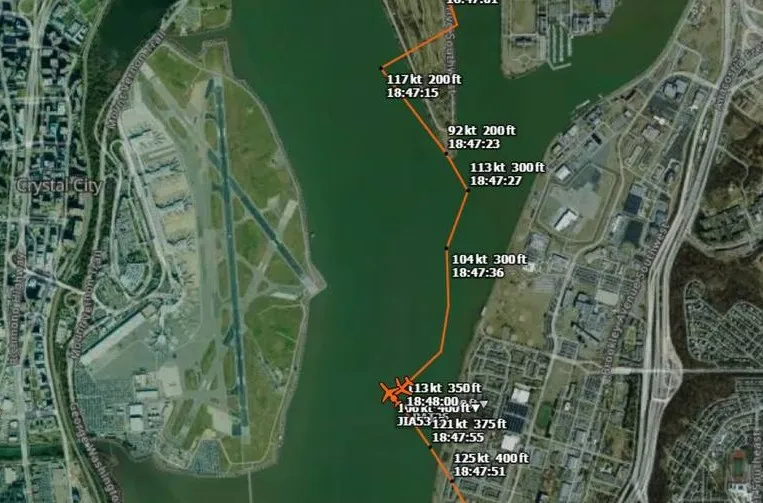
The helicopter that crashed into an American Airlines CRJ 700 with 60 passengers and four crew over the Potomac River in Washington DC changed course six times in the minutes before the crash.
It has also been revealed that the helicopter was not broadcasting its ADSB tracking signal which would have been picked up by the American Airlines Traffic Collision Avoidance System or TCAS which would have alerted the crew with a Traffic Alert. However, its location and course were being estimated by ADS-B Exchange using multilateration or MLAT.
The CRJ700 was operating Flight 5342 of American Airlines and it departed from Wichita, Kansas, earlier on Wednesday.
The American Airlines flight was operated by PSA which is a regional airline that operates flights on behalf of American and has 95 CRJ aircraft.
All take-offs and landings have been halted at Reagan National Airport, although the airport is expected to be opened in the morning.
The Black-Hawk was reportedly tracked near CIA headquarters and helicopters are frequently using the airspace for a variety of missions.
This helicopter, was part of the US Army Priority Airlift Battalion (USAPAT) and is used by VIP military officers and had 3 military personnel on board.
The CRJ was fitted with TCAS and so was the helicopter but that system is totally dependent on picking up the ADSB signal from the other conflicting aircraft.
TCAS has been mandated since 1993.
It was prompted by the mid-air collision in the western United States on June 30, 1956, when a United Airlines Douglas DC-7 struck a Trans World Airlines Lockheed L-1049 Super Constellation over Grand Canyon National Park, Arizona.
Further impetus came after the PSA 727 mid-air collision with a Cessna 172 over San Diego in 1978 which killed 144 including none on the ground.