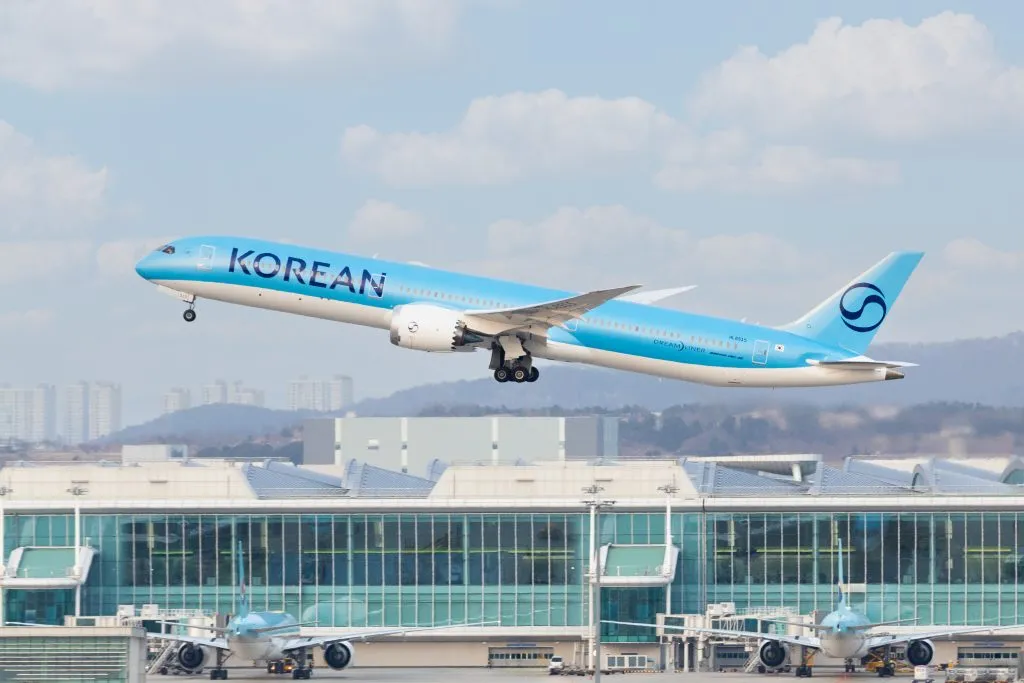
Korean Air has announced one of the largest investment programs in its history, signing agreements worth approximately USD 50 billion (KRW 70 trillion) with Boeing, GE Aerospace, and CFM International.
At a ceremony in Washington, D.C., the airline formalized orders for 103 next-generation aircraft from Boeing, 19 spare engines, and a 20-year engine maintenance program with GE Aerospace. The signing was attended by Walter Cho, Chairman and CEO of Korean Air and Hanjin Group; Stephanie Pope, President and CEO of Boeing Commercial Airplanes; and Russell Stokes, President and CEO of Commercial Engines & Services at GE Aerospace.
Massive Aircraft and Engine Investments
The centerpiece of the deal is a USD 36.2 billion (KRW 50 trillion) order for new aircraft, including:
- 20 Boeing 777-9s
- 25 Boeing 787-10s
- 50 Boeing 737-10s
- Eight Boeing 777-8F freighters
Deliveries are scheduled in phases through 2030. Korean Air will also purchase 11 spare engines from GE Aerospace and eight from CFM International, valued at USD 690 million (KRW 1 trillion). In addition, a 20-year GE Aerospace maintenance contract for 28 aircraft engines is valued at USD 13 billion (KRW 18.2 trillion).
Supporting Growth and Integration
The purchase comes as Korean Air prepares for its integration with Asiana Airlines, ensuring fleet expansion through the mid-to-late 2030s. Industry-wide delivery delays factored into the long-term planning, the airline said.
Korean Air’s fleet strategy is centered on operating five fuel-efficient families of aircraft: Boeing 777, 787, and 737 models alongside the Airbus A350 and A321-neo. The streamlined approach is expected to cut carbon emissions, improve operating efficiency, and enhance customer service.
Strengthening U.S. Partnerships
The deal also underscores Korean Air’s close ties with the U.S. aerospace industry, a partnership dating back to its first U.S. routes in the early 1970s. Today, the airline collaborates with Pratt & Whitney, GE, Hamilton Sundstrand, Honeywell, and maintains a trans-Pacific joint venture with Delta Air Lines.
Walter Cho said the latest investment reflects the airline’s commitment to strengthening global competitiveness while maintaining its role as a key bridge between South Korea and the United States.