The disappearance of Malaysia Airlines Flight MH370 remains the most complex and unresolved investigation in modern aviation. On 8 March 2014, a Boeing 777 carrying 239 passengers and crew departed Kuala Lumpur for Beijing and disappeared less than an hour into the flight without a distress signal or confirmed crash site.
More than a decade later, the case is defined not by a single failure point but by a series of unresolved variables spanning radar data, satellite tracking, human factors, search execution and emerging analytical techniques.
Here are unanswered questions:
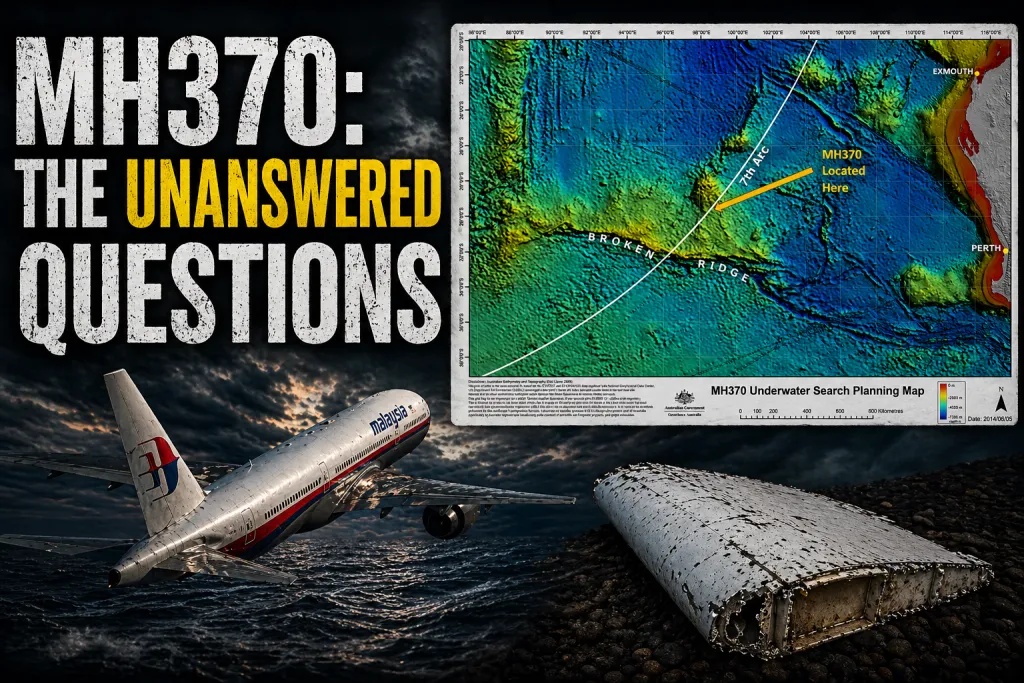
First: Primary military radar later confirmed that the aircraft did not continue along its planned route but instead turned back across Peninsular Malaysia and proceeded west toward the Andaman Sea. This information, however, was not fully integrated into the initial response, which focused on the South China Sea based on the last civilian radar return. The delay in incorporating that data resulted in a misallocation of resources during the critical early phase, and by the time the search shifted westward, opportunities for accurate surface drift modelling had already begun to diminish. Why was there a delay. With conventional tracking unavailable, investigators relied heavily on satellite communications data from Inmarsat. Analysis of handshake signals between the aircraft and satellite generated a series of arcs extending into the southern Indian Ocean, which became the basis of the primary search zone. These data points provided no direct positional fixes, no confirmed altitude information and only limited insight into onboard systems, leaving the final trajectory modelled rather than definitively established.
Second: Physical evidence has remained scarce, with confirmed debris recovered across a wide geographic range including Réunion Island, Mozambique, Tanzania, Madagascar and South Africa. While drift modelling broadly supports an impact site in the southern Indian Ocean consistent with satellite analysis, no concentrated debris field has been identified, no high-density structural components or cabin interior sections have been recovered and the flight recorders have not been located, significantly constraining conclusions about the aircraft’s final state and impact dynamics.
Third: In the earliest days of the search, satellite imagery identified multiple potential debris objects and aircraft and maritime assets were tasked to investigate them, yet many of these sightings were never confirmed. In a case defined by limited physical evidence, this represents a lost opportunity, as even negative findings could have refined search parameters or eliminated false leads more conclusively.
Fourth: The aircraft itself offers few answers. The Boeing 777 has one of the best safety records in commercial aviation, with no known systemic design failure capable of disabling all communications while allowing the aircraft to remain airborne for several hours. Electrical or systems failures would typically generate detectable secondary effects, and investigators have found no mechanical or design-based explanation consistent with the available data.
Fifth: Attention therefore extends to human factors. Captain Zaharie Ahmad Shah was publicly cleared of wrongdoing in the Malaysian final report. Data recovered from his home flight simulator contained a route extending into the southern Indian Ocean, with Malaysian authorities characterising the data as incomplete while Australian investigators assessed it as a continuous track, highlighting a divergence in interpretation rather than in the data itself. Aspects of the captain’s personal life surfaced briefly in public reporting but were not extensively developed in official findings, despite human factors typically being examined in depth in major aviation investigations.
The search itself evolved through multiple phases, beginning in the South China Sea before shifting to the southern Indian Ocean based on satellite analysis and ultimately becoming the largest and most expensive search effort in aviation history. It was suspended in 2017 after approximately 120,000 square kilometres had been covered without success.
Sixth: Responsibility shifted back to Malaysia, and although proposals for renewed searches emerged, including a “no find, no fee” model, agreement was not immediate and negotiations were protracted. In 2018, Ocean Infinity conducted a renewed search using autonomous underwater vehicles. The operation concluded without locating the wreckage and without extension, leaving open questions about contractual boundaries, duration and whether additional high-probability areas remained unsearched.
Seventh: Despite confirmed debris washing ashore across multiple regions, there was no coordinated global incentive system to encourage further recovery, potentially limiting the total volume of material available for analysis.
Eighth: Debris that was found was never picked up by Malaysia. Why?
Ninth: The most recent search by Ocean Infinity was abandoned early with no satisfactory explanation as to why.
Tenth: The most puzzling. More recently, alternative analytical methods have emerged, including work based on Weak Signal Propagation Reporter data, a global network of low-power radio transmissions. Research led by Richard Godfrey proposes that aircraft crossing these signal paths create disturbances that can be reconstructed into a flight track, producing a potential crash location outside previously searched areas. The methodology remains contested in some circles but has been positively peer reviewed by many academics.
It beggars’ belief that it was not searched. Yet this proposed search area has never been explored. By any measure, it is a missed opportunity—another door left unopened.
History is filled with technologies that were once dismissed—only to later prove their value. Some of the most important breakthroughs in history were not recognised when they first appeared. They were dismissed… overlooked… or simply misunderstood.
Edward Jenner took five years to convince the academic world of the vaccine for Small Pox – one of the world’s deadliest diseases.
Penicillin began as a contaminated experiment, while X-rays were once an impossible idea—seeing inside the human body without surgery. Radioactivity was first mistaken for an error on a photographic plate.
Plate Tectonics was ridiculed for decades. Helicobacter pylori was dismissed until one scientist proved it—on himself. (That was ulcers were not caused by stress but a virus.)
Cosmic Microwave Background Radiation was written off as interference… even blamed on pigeons, while signals from Pulsars were jokingly called alien transmissions.
A melted chocolate bar led to the Microwave Oven, while staying in the kitchen a failed experiment created Teflon.
And in the depths of the ocean, Deep Sea Hydrothermal Vents revealed life where none was thought possible.
And what about Viagra? Pfizer originally discovered the medication in 1989 while looking for a treatment for angina. Time and again, the unexpected has been ignored…until it could no longer be.
And that raises a question.
When it comes to MH370. Are are we certain every possibility has truly been explored? Or are there still ideas—, controversial perhaps…left just beyond the boundaries of where we’ve chosen to look?
There is a pattern in the history of discovery. Ideas that seem unlikely, inconvenient, even implausible—are often the ones dismissed first.
And yet, time and again, those same ideas return. Stronger. Clearer. Proven.
From penicillin… to plate tectonics… to the faint signal that confirmed the Big Bang—progress has often begun at the edge of doubt.
MH370 sits in that same space.
A mystery defined not just by what we know… but by what we may have chosen not to pursue.
WSPR is one of those ideas.
Controversial and questioned in some quarters but why? It has been proven by many academics.
And that is the point.
Because until every credible pathway has been explored—until every viable search area has been examined—we are not at the end of this story.
We are still in the middle of it. And somewhere, beyond the boundaries of where we have already looked… the answer is waiting.