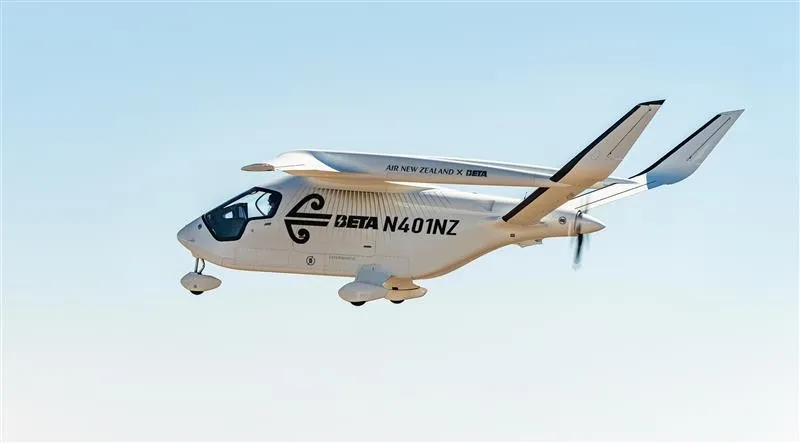
Air New Zealand has taken a bold stride into the future of flight, officially launching its Next Generation Aircraft Technical Demonstrator Program with the arrival of the BETA ALIA CX300 — the airline’s first-ever fully electric aircraft.
In a milestone moment for both the airline and the country, the sleek white aircraft bearing the koru on its tail will spend the next four months flying across New Zealand, testing the boundaries of zero-emission aviation.
SEE Air New Zealand’s Environmental, Safety and Product Rankings.
Beginning its proving programme in Hamilton, the ALIA CX300 will later head south via Taupō, Napier, and Palmerston North before reaching Wellington and preparing for Cook Strait crossings to Blenheim by the end of January.
The launch follows months of collaboration between Air New Zealand, US-based manufacturer BETA Technologies, the Civil Aviation Authority (CAA), and several airport partners — all focused on ensuring the aircraft can be safely operated and closely monitored in New Zealand’s unique conditions.
Air New Zealand pilots Andrew Mercer and James Owen will fly the demonstrator alongside BETA’s engineers and operations team, testing performance, training systems, and flight procedures that could one day shape electric aviation worldwide.
Air New Zealand Chief Executive Nikhil Ravishankar (below) said the project is a defining step in the airline’s future fleet strategy.

“Sixty percent of regional flights in New Zealand are under 350 kilometres, and about 85 percent of our electricity is renewable — the perfect laboratory for next-generation aircraft,” Ravishankar said.
“New Zealand has always had a pioneering spirit. Bringing the ALIA CX300 here represents true collaboration — a world-leading innovator in BETA Technologies working hand-in-hand with Kiwi engineers, pilots, regulators, and airports. Together, we’re helping shape what sustainable aviation looks like when it’s ready to scale.”
Simon Newitt, BETA Technologies’ Head of Global Sales, said operating in New Zealand offers vital real-world data for the aircraft’s global rollout.
“This programme marks an exciting milestone as we begin operational flights with Air New Zealand,” Newitt said. “It demonstrates how airlines, regulators, and infrastructure partners can work together to safely bring lower-emission, lower-cost aircraft into service.”
Hamilton Airport Chief Executive Mark Morgan said the region’s airspace offers an ideal test environment.
“It’s a privilege to host the first phase of flights for the ALIA CX300,” he said. “Hamilton provides the perfect setting to learn what systems, infrastructure, and logistics will support next-generation aircraft across the country.”
CAA Director and Chief Executive Kane Patena said the programme is just as important for regulators as it is for operators.
“Emerging aviation technologies don’t always fit into existing rules,” Patena said. “The technical demonstrator allows us to better understand these new systems and design the frameworks needed to safely integrate them into New Zealand’s aviation network.”
As the ALIA CX300’s quiet rotors spin up for take-off, its journey represents more than a technological test flight — it’s a glimpse into a cleaner, more connected aviation future. For Air New Zealand, it’s one small step in the sky, and one giant leap toward sustainable flight.