When Airbus handed over its 12,260th A320, surpassing Boeing’s 737 as the most-delivered jet in history, few paused to recall the extraordinary corporate near-miss that might have rewritten aviation’s balance sheet.
In the late 1980s, Airbus and McDonnell Douglas (MDC) came within days of sealing a merger that could have combined Europe’s innovation with America’s reputation for manufacturing and market reach — a transatlantic superpower capable of eclipsing Boeing before the turn of the century.
The talks collapsed in a single lunch meeting. The consequences reshaped commercial aviation for decades.
By the early 1980s, Douglas Aircraft — once synonymous with American jet innovation — was fighting for survival. The DC-8 and DC-9 families that had defined the jet age were aging fast, and the DC-10 had been tarnished by safety controversies. In 1981, Airbus overtook McDonnell Douglas in annual orders for the first time: 64 against just 37 for Douglas’s commercial line. Lockheed bowed out of the airliner market, closing its TriStar production line, and the once-mighty Douglas found itself with no DC-10 deliveries scheduled beyond 1982 and only 45 Super 80s on order.
A 150-seat jet dubbed the “New Commercial Aircraft” (NCA) was proposed as a modern, efficient replacement for the DC-9, and in May 1981 MDC signed a memorandum with Fokker to develop a joint variant, the MDF-100. But with the global airline industry in recession, the project was cancelled within a year. Douglas’s commercial pipeline dried up.
What saved the company, temporarily, was not passengers but the Pentagon. A contract for 60 KC-10A Extender tankers, adapted from the DC-10-30CF, kept Long Beach busy and balance sheets solvent. The military work brought short-term stability — but also bred complacency.
Douglas Aircraft’s leadership was weary of interference from the McDonnell family in St. Louis, whose interests leaned toward defense profits rather than long-term civil investment. In early 1982, Douglas chief John Brizendine resigned. His replacement, Jim Worsham — a dynamic executive from GE’s marketing division — arrived just as deregulation was transforming the U.S. airline market.
Worsham understood the shift. The new hub-and-spoke networks demanded mid-range, 150-seat aircraft — exactly the market Airbus would later conquer with the A320.
To regain momentum, Worsham (left below) introduced an inventive “rent-a-plane” financing model that won orders from TWA and American Airlines for 35 DC-9 Super 80s, and another 30 from Alitalia. “Reports of Douglas’s death were exaggerated,” he told The Los Angeles Times in late 1982.
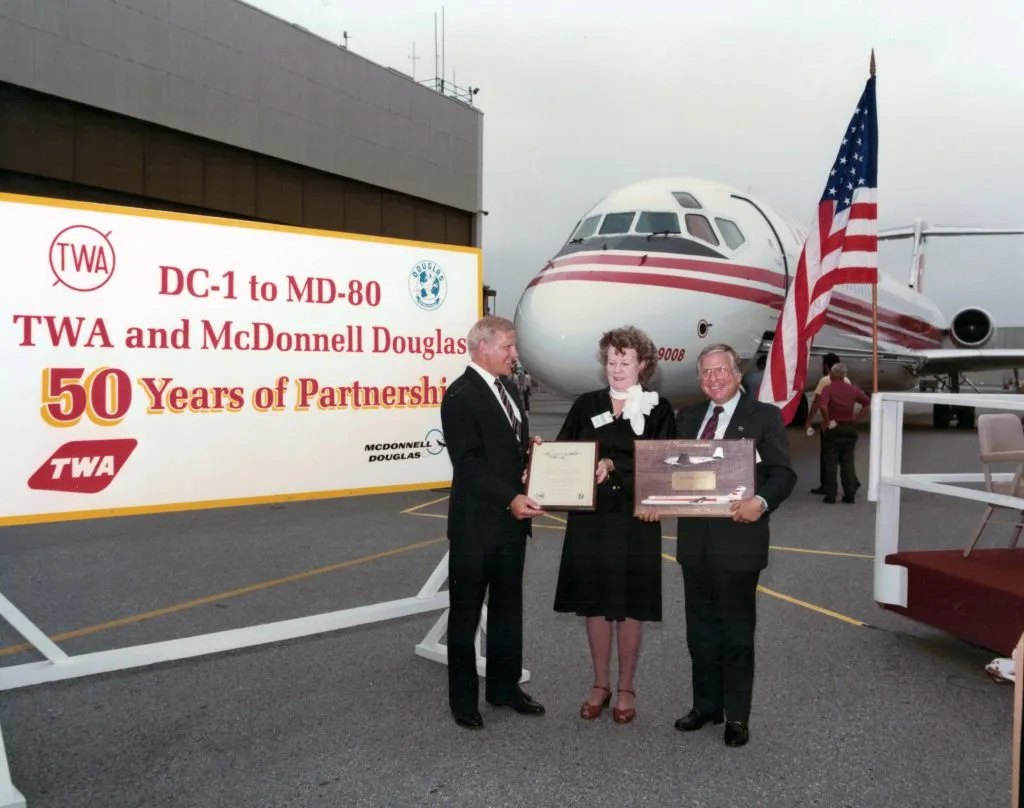
His optimism was justified, at least for a while. By 1987, the rebranded MD-80 was rolling off the line at ten aircraft a month. Douglas was profitable again — but built on legacy designs, not new ideas.
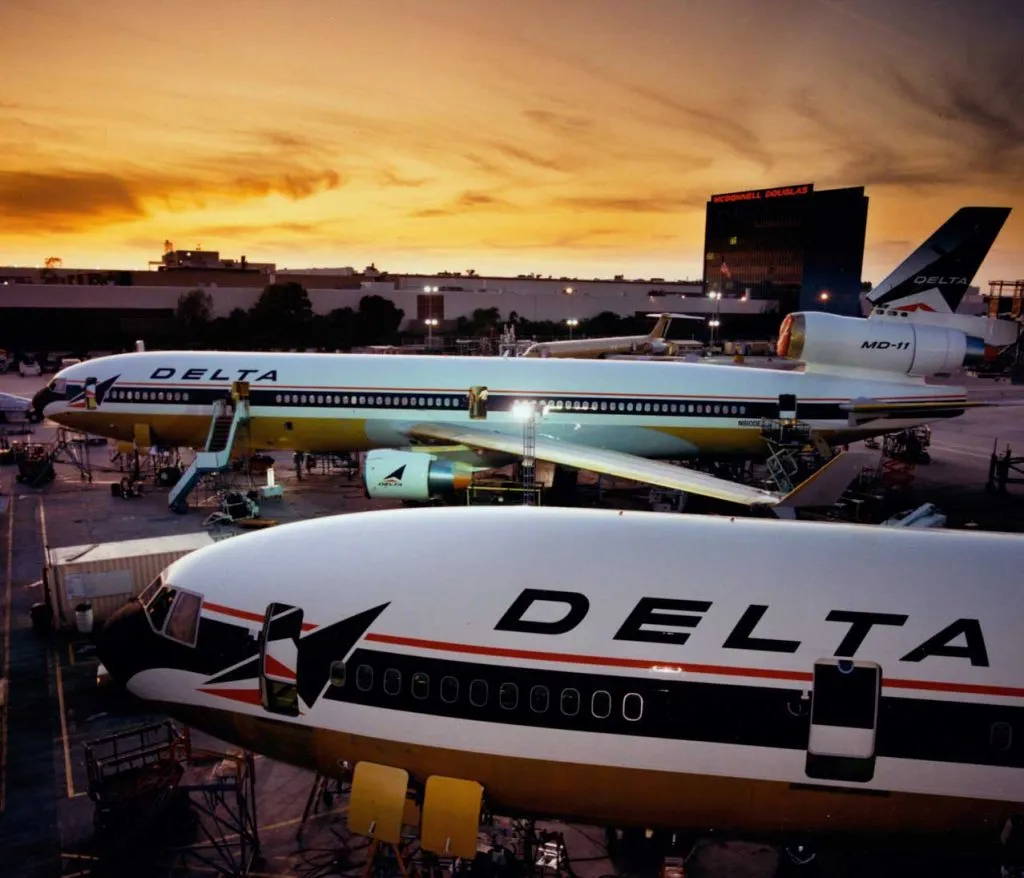
Flush with renewed cash flow, MDC’s board approved the MD-11, a stretched and modernized successor to the DC-10. It was meant to restore the company’s widebody credibility.
But behind the scenes, the finance department had already stripped the project of the single element that could have made it competitive: a new wing. The decision, driven by cost concerns and shareholder caution, forced engineers to rely on aerodynamic tweaks and more efficient engines rather than a clean-sheet structure.
The result was a compromised aircraft that never met its promised range or efficiency. By 1987, as Airbus readied its twin-engine A330 and A340, the MD-11 was already behind the curve.
Worsham later reflected that the board’s unwillingness to invest “sowed the seeds for our collapse.” Yet even as technical problems mounted, MDC’s leadership began to think in global terms. It was time, they believed, to look across the Atlantic — toward Airbus.
At that moment, Airbus was the industry’s young disruptor — a politically complex, government-backed consortium of France, Germany, Britain, and Spain. Its early aircraft, the A300 and A310, had carved a foothold in Asia and Europe but struggled in the United States. In 1987, Airbus jets made up less than two percent of the U.S. fleet, though nearly 200 were on order.
What Airbus lacked was U.S. industrial credibility and domestic market penetration. McDonnell Douglas offered both: a century of brand equity, a massive manufacturing base in Long Beach and St Louis, and established customer relationships with every major U.S. carrier.
For MDC, the incentive was equally clear. Partnering with Airbus meant access to European capital, new technology — especially Airbus’s revolutionary fly-by-wire flight control systems — and a path out of the design dead-end that the MD-11 represented.
By late 1987, Worsham was in direct talks with Airbus executives. He proposed a partnership built around shared programs: an MD-11 derivative using the A330/A340 wing, known internally as the AM-300, which could challenge Boeing’s 747; and joint production of smaller aircraft, possibly including the A320 and a new 100-seat single-aisle jet.
The idea gathered momentum quickly. European government ministers encouraged Airbus to explore the tie-up, granting a four-month window in 1988 to finalize an agreement.
Plans were drawn for joint assembly of the A320 and the C-17 transport in Long Beach, while the AM-300 would be built in Utah. A U.S. A321 line was envisioned to satisfy domestic airlines wary of European supply chains.
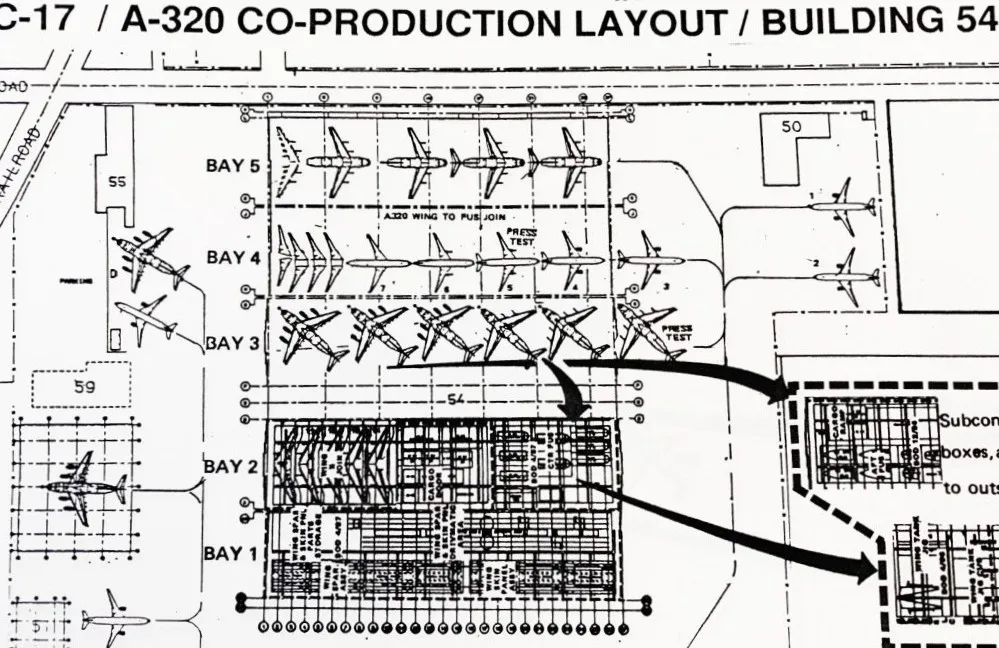
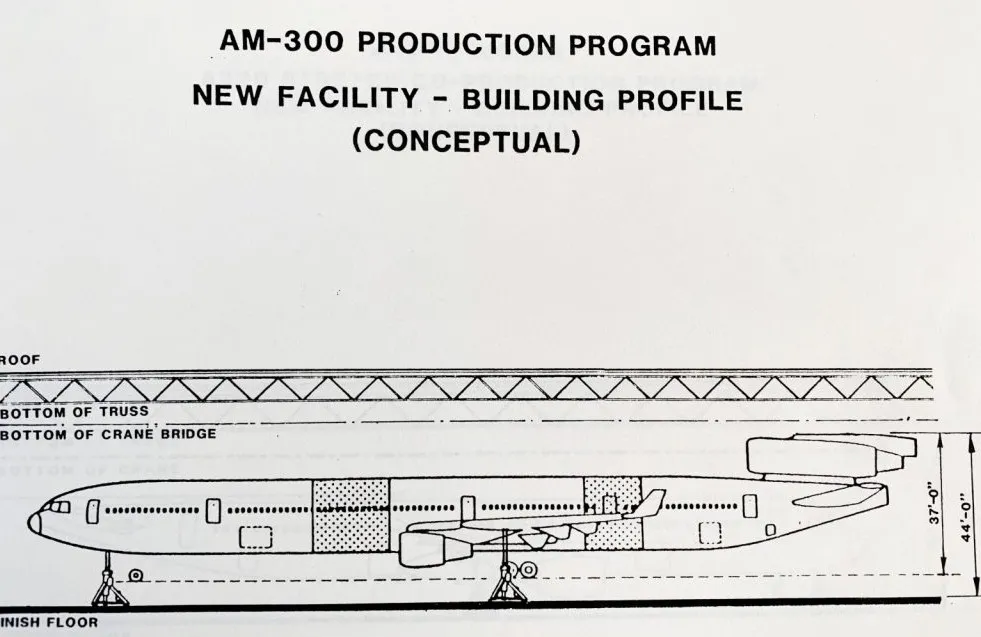
Airbus’s Adam Brown, then vice president of customer affairs, recalled that Worsham “believed that Airbus and MDC could collaborate on a single program while continuing to compete in others — the MD-11 against the A330/A340, the MD-90 against the A320.”
Jean Pierson, Airbus’s CEO, disagreed. “If we were to get together,” he told Brown, “it would have to be a complete marriage across the whole product line.”
Under the draft terms, Airbus and MDC would merge their commercial programs into a single portfolio. The AM-300 would sit at the top of the range, offered with either Airbus or MDC avionics and cockpits to appeal to both customer bases. Workshare would be evenly divided, with revenue proportional to investment. MDC agreed to phase out the MD-11 once the joint program took effect.
For the first time, Douglas engineers saw a credible future beyond incremental derivatives. Long Beach could have become the A321 production hub for the United States, cementing Airbus’s transatlantic presence nearly three decades before it finally built an assembly line in Mobile, Alabama.
Then, in the spring of 1988, came the fateful lunch.
Franz-Josef Strauss (below), chairman of the Airbus Supervisory Board and a dominant figure in German politics, met John McDonnell, the newly appointed MDC chairman, to settle the last major dispute: how to define the next-generation 100-seat aircraft.

Airbus insisted it must use its proprietary fly-by-wire system — a core technological differentiator. McDonnell (below) countered that to preserve “external balance,” it must be recognizably an MDC design derived from the MD-90.

The conversation quickly soured. According to Worsham, Strauss “suggested that Douglas didn’t have a hell of a lot to offer with old technology and obsolete stuff,” a remark that McDonnell took as a personal insult. Within 45 minutes, the merger was effectively dead.
An Airbus official later described Strauss as “a strong-willed, sometimes controversial German politician who had made aviation his specialty.” He died of a heart attack a few months later.
But the real casualty was Douglas. The deal, once described by European ministers as “win-win,” evaporated overnight. The press release was drafted — but never sent.
For Airbus, the collapse was disappointing but not disastrous. The A320 was already gaining traction, with several hundred orders on the books. Freed from the complications of a transatlantic marriage, Airbus doubled down on its independent strategy, investing heavily in the A330 and A340 families and laying the groundwork for the A380 and later the A350.
For McDonnell Douglas, the repercussions were terminal.
John McDonnell, buoyed by record MD-80 sales — more than 100 annually through the late 1980s — believed the company’s commercial revival was secure. The MD-11, he argued, would soon deliver major orders, including a lucrative contract from Delta. He saw no need for a European alliance.
But that optimism ignored the underlying rot. The MD-11’s (below) performance shortfalls soon became evident. Its promised range of 7,920 nautical miles fell well short in service. Fuel efficiency lagged. Airlines cancelled or deferred orders. The aircraft was no match for Airbus’s new widebodies or Boeing’s 777, which arrived in 1995 as the ultimate expression of what the MD-11 should have been.
In 1997, McDonnell Douglas merged with Boeing — not as an equal, but as a junior partner absorbed into a stronger balance sheet. Boeing acquired MDC’s defense business and its residual jet programs, but the Douglas name disappeared from the skies.
To many within the industry, it was a corporate tragedy foretold. “The refusal to invest in a new wing and the failure to close with Airbus were the two fatal errors,” one former executive reflected years later. “They saved millions to lose billions.”
Had the Airbus–Douglas merger succeeded, the landscape of global aviation might look radically different today.
Airbus would have gained immediate access to U.S. production, suppliers, and airlines — perhaps accelerating its rise by a decade. McDonnell Douglas would have gained European financing and fly-by-wire technology, bridging the innovation gap that later doomed its product line.
A combined Airbus–Douglas entity could have fielded a unified family spanning the A320, AM-300, and A330/A340 — directly challenging Boeing across every segment. The U.S. domestic market, which took Airbus nearly 30 years to penetrate, might have been conquered by 1990.
Instead, the two paths diverged completely. Airbus went on to challenge and beat Boeing in the single-aisle sector. McDonnell Douglas vanished into Boeing’s archives, remembered only through the few remaining MD-11 freighters still flying under FedEx and UPS colors.
In hindsight, the episode reads less as an industrial accident than as a lesson in corporate psychology.
McDonnell Douglas had technology, market knowledge, and a valuable brand. What it lacked was confidence — and patience. Short-term cost control triumphed over long-term vision. The refusal to fund an all-new wing, the hesitation to embrace Airbus, and the cultural insularity of the McDonnell board all reflected a company ruled by accountants, not engineers.
Airbus, by contrast, was the embodiment of long-term political investment. Governments underwrote development costs precisely to weather short-term losses. The Airbus consortium’s willingness to think in decades rather than quarters was the ultimate competitive edge.
Today, as investors celebrate Airbus’s production record, the story of McDonnell Douglas serves as a sobering parable for boardrooms everywhere: in aerospace, innovation is capital-intensive, collaboration is essential, and strategic ego is lethal.
When Airbus executives toasted their 12,260th A320 delivery, few may have recalled that the aircraft’s first flight in 1988 coincided almost exactly with the collapse of the MDC deal.
The A320 could have been a joint product, assembled in Long Beach under a shared banner. Instead, it became the symbol of Airbus’s independence — and the machine that ultimately buried McDonnell Douglas in the history it might have written.