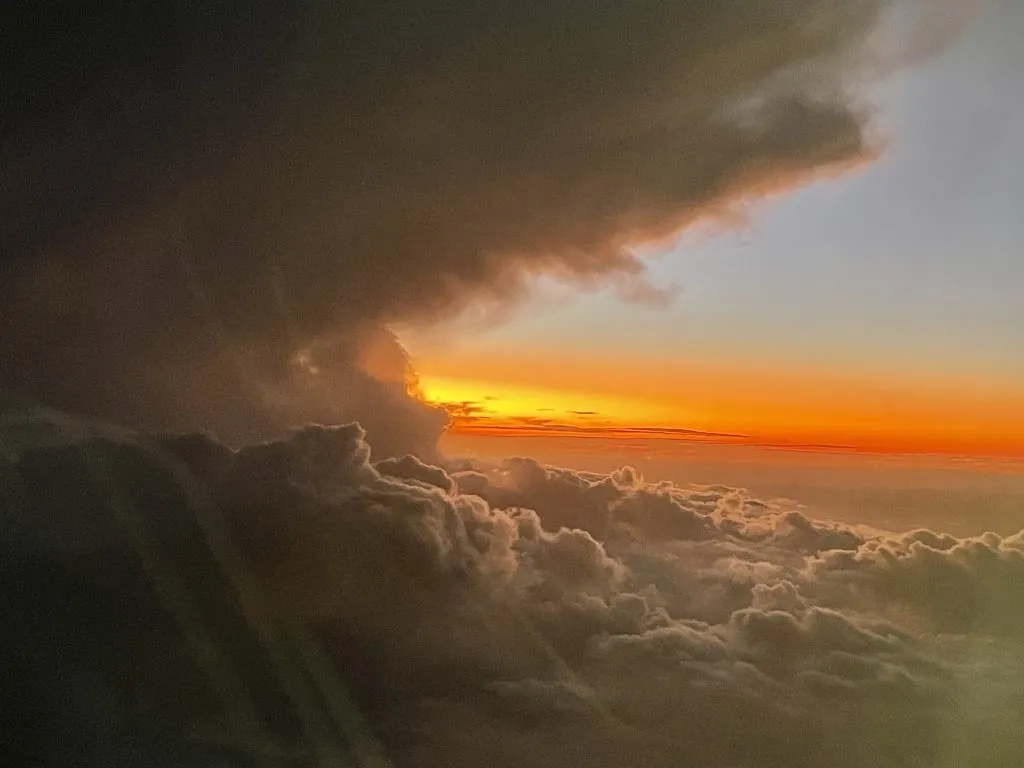
The skies are not so friendly and are getting far more turbulent. Climate change is the big reason and it’s going to get worse with severe turbulence set to double.
A new study “Future Trends in Upper-Atmospheric Shear Instability from Climate Change” by de Medeiros & Williams (2025) from the University of Reading in the UK warns that air turbulence at cruising altitudes is set to increase significantly by the end of this century. Using the world’s most advanced climate models, researchers looked at how jet streams — the high-speed rivers of air that circle the planet — will respond to global warming. Their conclusion: stronger winds, less stability, and skies that are more prone to jolts.
For passengers, that means one thing: bumpier flights ahead.
Why turbulence happens
Airplanes cruise at altitudes of about 33,000 to 39,000 feet. Up there, the jet stream acts like a superhighway of fast-moving air. Pilots often use it to save time and fuel, riding the currents when they’re flowing in the right direction. But the same winds that speed things up can also make flying rough.
Turbulence happens when layers of air move at different speeds or directions. If the difference — known as “wind shear” — gets strong enough, the air becomes unstable.
Not all turbulence is created equal. Some is linked to storms and clouds, but the type most feared by pilots and passengers is clear-air turbulence. It strikes suddenly, without visual warning, and often when people are unbuckled. Airlines say it’s the leading cause of in-flight injuries.
What climate change has to do with it
The new research shows that as the planet warms, the temperature difference between the equator and the poles is shifting. This change strengthens the jet stream at certain altitudes. Stronger jets mean stronger shear. And when combined with a less stable atmosphere, it creates the perfect recipe for more turbulence.
In plain terms: climate change is re-engineering the atmosphere in ways that make bumpy flights more likely.
The study used 26 global climate models, running them forward to the year 2100 under two scenarios — one where greenhouse gas emissions keep rising steeply, and another where the world takes moderate action to cut them. In both futures, turbulence increases. But in the high-emissions world, the effect is almost twice as strong.
What the numbers say
Here’s the bottom line from the study:
Mid-latitudes — the busy flight corridors across the North Atlantic and North Pacific — will see the sharpest rise.
By 2100, turbulence conditions could increase by 16 to 34 percent compared to today.
The Northern Hemisphere is hit harder than the Southern Hemisphere.
The most severe turbulence episodes — not just average bumps — will become much more common.
In the worst case, the most extreme turbulence events could nearly double in frequency.
Even under a middle-of-the-road climate scenario, turbulence increases noticeably.
In short: turbulence is not going away. It’s set to become a routine part of future air travel.
What it means for passengers
For most travelers, turbulence is scary but rarely dangerous. Modern aircraft are designed to handle the stresses with ease. What does matter is whether passengers and crew are prepared.
Injuries: The majority of turbulence-related injuries happen when people aren’t wearing seatbelts — or when flight attendants are in the aisle. Even a short, sharp jolt can throw someone into the ceiling.
Delays and costs: Turbulence forces rerouting, burns extra fuel, and leads to costly repairs or medical diversions. Airlines already spend millions each year dealing with it, and those bills are expected to rise.
Comfort: Turbulence disrupts sleep, spills meals, and makes flying more stressful for nervous travelers.
The takeaway: buckling up, even when the sign is off, is more important than ever.
How airlines and pilots are adapting
Airlines are not standing still. Advances in forecasting and onboard radar help crews avoid known rough patches, but clear-air turbulence remains difficult to predict because it’s invisible to the eye and instruments. New technologies, such as satellites and improved computer models, are giving pilots better warnings, but the challenge is far from solved.
Some airlines are investing in real-time turbulence reporting, where aircraft automatically send data about bumpy conditions to those following behind. That helps crews adjust flight paths on the fly. But with global warming raising the background level of risk, avoidance will only get harder.
The bigger picture
The turbulence story is just one piece of how climate change is reshaping aviation. Rising temperatures also affect aircraft performance, fuel use, and flight schedules. More frequent extreme weather — storms, heat waves, flooding — creates new challenges for airports and air traffic systems.
But turbulence stands out because it’s something passengers feel directly in their seats. It’s a reminder that climate change is not just an abstract concept or a distant threat. It’s literally shaking the way we move around the planet.
What passengers can do
While no one can change the atmosphere from the cabin, travelers can take steps to stay safe and comfortable:
- Keep your seatbelt fastened whenever you’re seated, even if the light is off.
- Stow belongings securely to prevent them from flying around.
- Listen to crew instructions — turbulence can come on suddenly.
- Stay calm: aircraft are built to withstand far worse than what passengers feel.
Looking ahead
The research serves as a wake-up call. Climate change isn’t just melting glaciers or raising sea levels — it’s changing the everyday experience of air travel. For millions of people who fly every year, the difference will be felt not in distant decades but increasingly in the seatbelt sign lighting up sooner and staying on longer.
As Professor Paul Williams, co-author of the study, has put it in past interviews: “The clear message is buckle up. The seatbelt sign may be on more often in the future.”