United Airlines, in a brilliant masterstroke, is going to turn economy travel on its head with a not so new concept pioneered by Air New Zealand.
For decades, the airline industry has treated economy class as a fixed equation: maximise seats, minimise space, and differentiate only at the front of the aircraft.
That equation is now being quietly rewritten—and United Airlines’ newly announced Relax Row may prove to be one of the smartest evolutions yet.
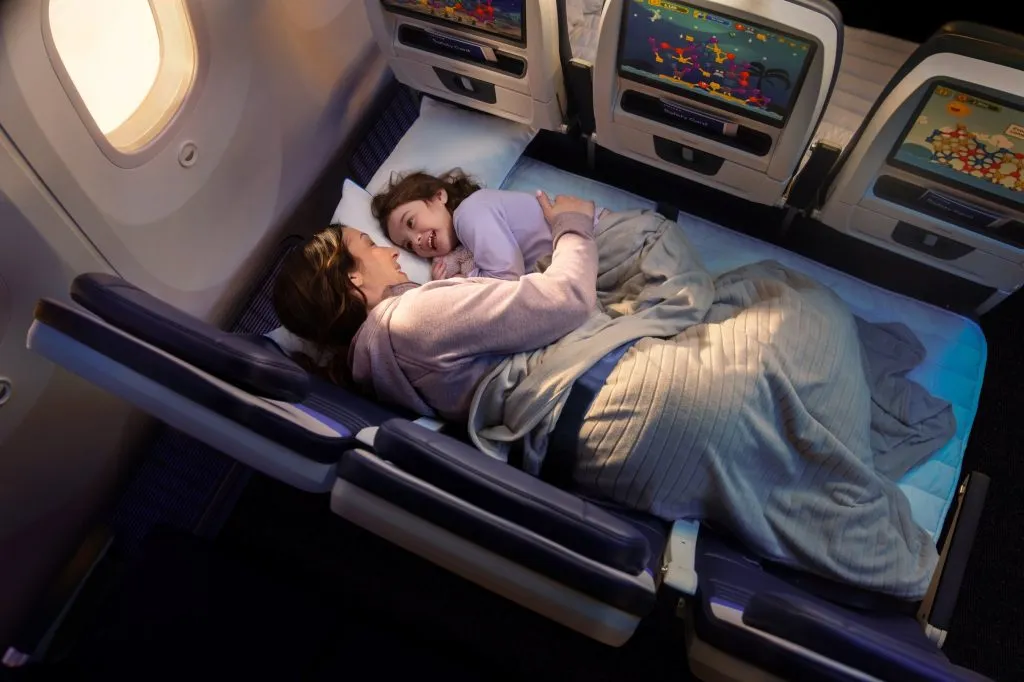
At first glance, the concept is deceptively simple: a row of three economy seats that converts into a couch-like space, complete with mattress pad, bedding and extra amenities. But beneath that simplicity lies a strategic shift that airlines have been inching toward for years—monetising space, not just seats.
And crucially, it’s not a new idea.
Long before United’s announcement, Air New Zealand pioneered the concept with its now-famous Skycouch—a product that transformed a standard economy row into a flexible sleeping and lounging space.
When it launched, the Skycouch was seen as quirky. A niche. A clever PR story.
In reality, it was something far more important: a rethinking of how economy class could be sold.
Instead of forcing passengers to “trade up” to premium cabins, Air New Zealand created a new category altogether—one that sat between economy and premium economy, capturing travellers who wanted comfort but couldn’t justify a full upgrade.
That insight has aged remarkably well.
What United has done is take that proven concept and apply it at scale—and at exactly the right moment.
The Relax Row is not positioned as a luxury indulgence. It’s framed as accessible comfort: ideal for families, couples, or solo travellers willing to pay a modest premium for space on long-haul flights.
United plans to roll this out across more than 200 widebody aircraft by 2030—embedding the concept into the backbone of its long-haul fleet rather than treating it as an experiment.
That’s a critical difference from earlier innovations in economy: this isn’t a trial. It’s a structural shift.
The brilliance of Relax Row lies in where it sits.
Airlines have long focused on upselling passengers into premium economy or business class. But there’s a vast segment of travellers who simply won’t—or can’t—make that leap.
Instead of selling three individual seats at standard economy fares, United can package them as a single, higher-yield product. The cost to implement is relatively low—no new cabin, no structural redesign—yet the revenue upside is significant.
It’s classic airline economics: extract more value from the same physical space.
Air New Zealand proved the concept works. United is proving it can scale.
Timing matters, and United’s move aligns neatly with how travel behaviour has evolved.
Long-haul economy passengers today are more experience-driven than ever. Sleep, personal space, and comfort have become priorities—not luxuries. At the same time, many travellers remain price-sensitive, particularly in a post-pandemic world where leisure demand dominates.
Relax Row sits squarely in that sweet spot: better than economy, cheaper than premium.
For families, it solves a real problem—how to manage children on long flights without upgrading the entire booking. For couples, it offers privacy. For solo travellers, it provides something airlines have rarely offered in economy: the ability to properly lie down.
Importantly, Relax Row isn’t an isolated idea. It fits seamlessly into United’s broader strategy, which has increasingly focused on premium differentiation across its network.
From lie-flat seats on narrowbody aircraft to enhanced Polaris cabins and upgraded regional jets, United is building a tiered product ladder—one that offers more choice at every level.
It acknowledges a simple truth: not every passenger wants—or needs—the full premium experience. But many are willing to pay for something better.
Air New Zealand’s Skycouch once felt like an outlier. With United now adopting—and scaling—the concept, it begins to look more like the future.
And as with many successful airline innovations, the real test will be imitation.
If Relax Row performs as expected, it’s easy to imagine other carriers following suit, just as they did with premium economy before it. What began as a niche product could evolve into a standard feature of long-haul cabins.
In the end, United’s Relax Row isn’t just about comfort. It’s about rethinking how airlines sell space.
It challenges the binary structure of cabins—economy versus premium—and replaces it with something more fluid, more adaptable, and ultimately more profitable.
Air New Zealand showed the industry what was possible.
United, with its scale and network, will be the airline that makes it inevitable.