United Airlines says goodbye to compromised flying of narrow seats, and crowded cabins, and says hello to a new dimension in premium travel.
Read United Opens Bookings for Luxury 787s
In a sweeping fleet and product announcement, the Chicago-based carrier has laid out one of the most ambitious premium expansions in modern aviation, anchored by a simple idea: bring the widebody experience to every corner of its network.
At the heart of that strategy is scale. United expects to take delivery of more than 250 aircraft by 2028—an unprecedented surge that will reshape not just its fleet, but the expectations of domestic and regional flying.
But this isn’t just about more planes. It’s about redefining what those planes offer.
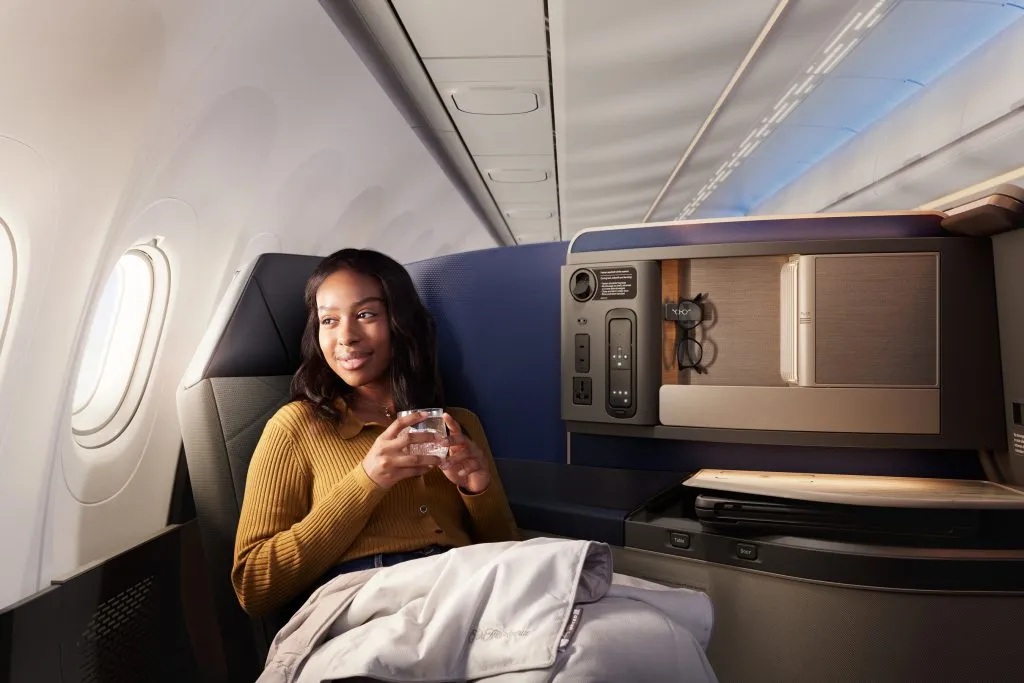
Perhaps the clearest signal of United’s direction is the introduction of the Airbus A321 “Coastliner”—a narrowbody aircraft designed with the sensibility of a long-haul jet. For the first time, lie-flat United Polaris seats—traditionally reserved for international routes—will appear on domestic transcontinental flights.
These aren’t scaled-down versions. They are full, all-aisle-access suites, engineered after years of development to maximise space, privacy and comfort. The implication is simple: United no longer sees premium as something for long-haul travellers, – its an expectation across its network.
The Coastliner will operate on some of the airline’s busiest and most competitive routes—linking San Francisco and Los Angeles with New York—where more than 10,000 passengers travel daily. It is here, in these high-stakes corridors, that United is choosing to make its boldest statement.
And for those at the front of the aircraft, the experience doesn’t stop at the seat. For the first time, domestic Polaris passengers will gain access to United’s flagship Polaris lounges—an amenity traditionally reserved for long-haul international travellers.
The strategy goes further with the Airbus A321XLR, a long-range narrowbody that allows United to rethink international flying itself.
With more premium seats than the Boeing 757 aircraft it replaces, the XLR opens new possibilities—thinner routes to Europe and South America that were previously uneconomical, but now viable with a high-yield, premium-focused configuration.
In essence, United is using aircraft flexibility to chase premium demand, rather than simply filling seats.
At the top end of the market, United is also sharpening its long-haul proposition. The new Boeing 787-9 “Elevated” interiors introduce Polaris Studio—larger, more private suites complete with sliding doors, companion seating and a level of finish that signals a clear push toward the global premium elite.
Details matter here: 27-inch 4K screens, caviar service, curated wine pairings. It is a product designed not just to compete, but to reposition United among the world’s leading premium carriers.
Perhaps most intriguing is how far down the network this philosophy now extends.
The new CRJ450 regional jet—serving smaller cities—has been reimagined to evoke a private jet experience, complete with spacious cabins and design choices that prioritise comfort over capacity. It reflects a broader truth: premium is no longer confined to widebodies or flagship routes.
Behind these product changes lies a deeper strategic shift. Since launching its “United Next” plan in 2021, the airline has increased premium seating by 40% on North American departures, modernised large parts of its fleet, and expanded aggressively across both the Atlantic and Pacific.
This latest announcement accelerates that trajectory. United isn’t simply adding capacity—it’s recalibrating the balance of its cabins, its aircraft, and ultimately its brand.
Even economy travellers are part of that story. Investments in Starlink Wi-Fi, improved onboard comfort, upgraded entertainment and enhanced food offerings suggest a recognition that a premium airline must elevate every cabin, not just the pointy end.
What United is really betting on is a shift in traveller expectations.
The lines between business and leisure travel have blurred. Premium demand is no longer confined to corporate contracts—it is increasingly driven by individuals willing to pay for comfort, reliability and experience.
By bringing premium features to more aircraft, more routes, and more passengers, United is positioning itself to capture that demand at scale.
It is a bold and costly move. But if the airline is right, and I know it is, the future of flying—whether from New York to Los Angeles or Chicago to a regional outpost—will feel a lot more like the front of the plane.