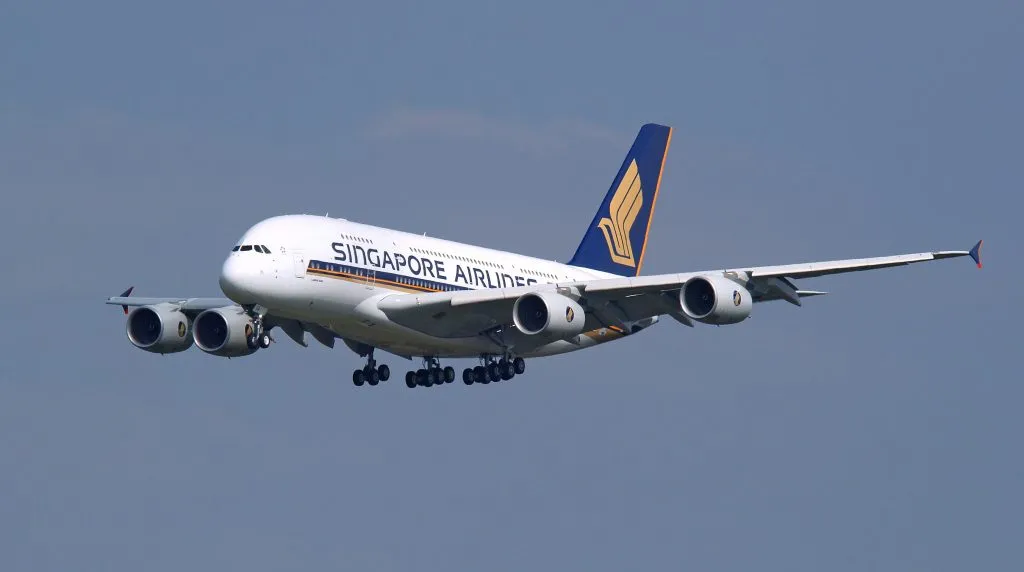
SIA Group Delivers Record Revenue and is paying its staff a seven month salary bonus.
Employees are getting a bonus equal to about seven and a half months of pay according to the Singapore based Business Times.
The incentive is part of a profit-sharing arrangement that delivered eight months pay last year and six and a half months in FY23.
READ: SIA Environmental and Product Rankings
Singapore Airlines (SIA) Group achieved a record group revenue of S$19.54 billion in the financial year ending 31 March 2025, marking a $527 million increase (+2.8%) year-on-year, underpinned by sustained global demand for both passenger and cargo air travel. The Group, comprising SIA and its low-cost carrier Scoot, saw its passenger count rise to an all-time high of 39.4 million, up 8.1% from the previous year.
SIA Group Passenger Growth Outpaces Revenue Gains
Despite the record passenger count, revenue growth in passenger services was moderate. Passenger flown revenue rose just 1.0% to $15.85 billion, as load factor and yields both slipped. The Group passenger load factor (PLF) fell 1.4 percentage points to 86.6%, as capacity expansion (+8.2%) outpaced traffic growth (+6.4%). Simultaneously, passenger yields dropped 5.5% to 10.3 cents per revenue passenger-kilometre, as global carriers ramped up capacity and intensified price competition.
In the second half of the financial year, the Group recorded its highest-ever half-yearly revenue of $10.04 billion, up $192 million (+1.9%), though gains were again constrained by declining yields. Revenue from passengers rose by a marginal $46 million (+0.6%), while cargo brought in an additional $52 million (+4.9%).
SIA Group Cargo Segment Rebounds on E-commerce and Disruptions to Sea Freight
Cargo flown revenue improved by $94 million (+4.4%) to $2.25 billion, driven by robust demand for e-commerce shipments, perishables, and a modal shift from sea to air due to disruptions in maritime logistics. Although the cargo load factor (CLF) rose 1.6 percentage points to 56.1%, yields fell 7.8% amid a more competitive cargo market.
In the second half, however, the CLF dropped 1.4 percentage points to 54.9%, with cargo yields down 2.1%, reflecting ongoing pricing pressures.
Costs Surge, Squeezing Operating Margins
The Group’s operating expenditure surged by $1.55 billion (+9.5%) to $17.83 billion, mainly due to a $1.24 billion (+11.0%) increase in non-fuel costs, attributed to capacity expansion and rising cost pressures across the aviation sector. These increases were partially offset by ongoing cost-management initiatives, such as digitalisation and productivity improvements.
Net fuel costs rose by $309 million (+6.1%), driven by higher uplift volume and reduced fuel hedging gains. This was partially counterbalanced by an 8.5% decline in fuel prices and favourable exchange rates.
As a result, Group operating profit declined sharply by $1.02 billion (-37.3%) to $1.71 billion, despite record revenues.
Profit Lifted by One-off Merger Gain
In contrast to the weaker operating profit, the Group’s net profit climbed to a record $2.78 billion, up $103 million (+3.9%). This was primarily due to a one-time, non-cash accounting gain of $1.10 billion from the completion of the Air India–Vistara merger in November 2024. The second half alone saw net profit jump 65% to $2.04 billion, again buoyed by the merger-related gain.
Robust Financial Position, Despite Cash Outflows
The Group ended the fiscal year with shareholder equity of $15.7 billion, a decline of $0.7 billion, largely due to the redemption of Mandatory Convertible Bonds (MCBs) and dividend payouts. Total debt fell $0.5 billion to $12.9 billion, maintaining a debt-equity ratio of 0.82.
Cash and bank balances dropped $3.0 billion to $8.3 billion, following heavy capital and investment expenditures—including a $1.7 billion MCB redemption, $1.8 billion in capital expenditure, $1.4 billion in dividends, and a $1.0 billion investment in Air India. The Group, however, retains $1.8 billion in long-term deposits and $3.3 billion in undrawn committed credit lines.
Strategic Expansion: New Fleet, Wider Network, AI Innovation
As of 31 March 2025, the Group operated a fleet of 205 aircraft with an average age of 7 years and 8 months. This included 145 aircraft under SIA, 53 under Scoot, and 7 freighters. The Group expanded further in April 2025 with the addition of an Airbus A321neo and Boeing 787-8, and currently has 78 aircraft on order, including new-generation Airbus, Boeing, and Embraer jets.
The Group’s passenger network spans 128 destinations across 36 countries and territories, while its cargo network reaches 132 destinations. Scoot recently launched flights to Iloilo City, and will begin service to Vienna in June 2025. SIA will boost flights to major cities like London (Gatwick), Seattle, and Johannesburg during the Northern Summer 2025 season.
In a strategic move, SIA deepened its partnership with All Nippon Airways (ANA), launching revenue-sharing flights between Singapore and Japan starting September 2025, with ticket sales opening this month. The collaboration aims to improve connectivity and offer more travel options for passengers and shippers alike.
Premium Product Investments
To strengthen its premium positioning, SIA is investing $1.1 billion in new long-haul cabin products for its Airbus A350-900 fleet, including the introduction of an entirely new First Class product on its ultra-long-range aircraft. Additionally, $45 million is being invested in renovating SIA lounges at Changi Airport Terminal 2, expanding capacity by 50% and upgrading amenities.
Leading in Digital Transformation
The Group is actively investing in Generative AI (GenAI) to enhance customer service and operational efficiency. Collaborations with Salesforce and OpenAI are enabling SIA to implement AI-powered applications that deliver personalised service and improve back-end functions.
Community Engagement: SG60 Celebrations
In conjunction with Singapore’s 60th anniversary, the Group launched SG60-themed fare deals and exclusive promotions across Kris+, KrisShop, and Pelago. A SG60 fundraising drive aims to raise $2.6 million, matched dollar-for-dollar by SIA, to benefit charities such as AWWA and Rainbow Centre.
Dividend and Shareholder Returns
SIA’s Board of Directors has proposed a final dividend of 30 cents per share, bringing the total FY2024/25 dividend to 40 cents per share. This amounts to a total payout of $1.2 billion, with the final dividend scheduled for payment on 27 August 2025, pending shareholder approval.
Outlook: Navigating Uncertainty with Strength
Looking ahead, the Group remains cautious amid a challenging macroeconomic environment characterised by geopolitical tensions, shifting trade policies, and supply chain disruptions. Nonetheless, SIA remains well-positioned to navigate these challenges.
Its dual-brand strategy, strong presence in growth markets across Asia-Pacific, and robust multi-hub strategy, including a 25.1% stake in Air India, provide significant growth opportunities. The Group also continues to invest in next-generation aircraft, digital capabilities, and customer-centric innovations to maintain competitiveness and ensure long-term value for shareholders.