Although Australian scientist David Warren is widely hailed as the inventor of the black box flight recorder, a Perth man named Robert Henry Orgill actually flew a similar device two years earlier, in 1956—long before Warren’s prototype took to the skies.
Recently uncovered photographs have cast fresh light on the tragic trajectory of Orgill’s life. He died by suicide in 1964—homeless, penniless, and seemingly without legacy. But a 1998 investigation by The West Australian’s chief feature editor Norm Aisbett, working with the author, revealed something startlingly different: a portrait of an unrecognised electrical genius undone by his own trusting nature.
In the early 1950s, the young Orgill opened World-Wide Electrics in Perth—its roof crowned by a massive illuminated globe that quickly became a local landmark. But he had already been working on a crash-proof flight-recording device since 1945, driven by the death of his brother in a RAAF accident in New Guinea.
By 1956, his invention was ready.
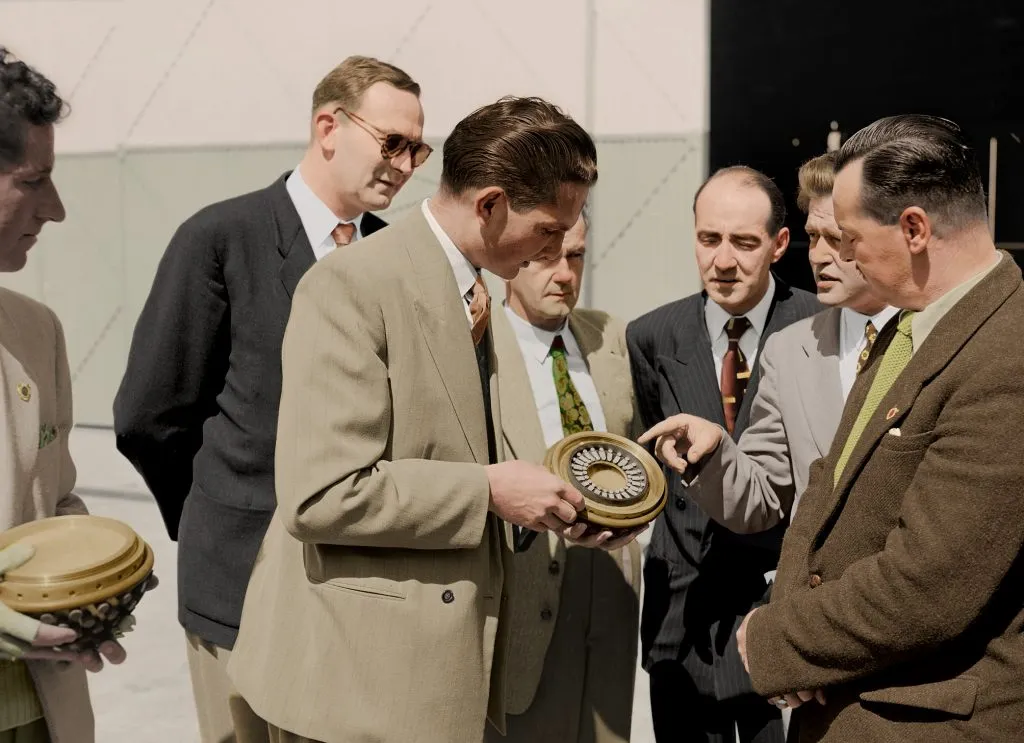
He called it the Orgill Air Safety Unit—a rubber-studded aluminium sphere just 19 cm across and weighing 4.5 kg. The shockproof, fireproof, and waterproof ball was designed to sit in an aircraft’s tail and, notably—echoing modern MH370 discussions—to eject itself automatically at the moment of impact.
Inside was a miniature mechanism capable of registering oil failures, engine faults, fuel issues, fires, decompression problems, metal fatigue, radio transmitter faults, and more. If any anomaly was detected, a cockpit recorder automatically activated to capture the pilots’ reactions.
On July 9, 1956, The West Australian ran the headline “Perth Invention Passes Test,” declaring the first flight trial of the Orgill unit a “complete success.” Four failures were simulated in real flight conditions.
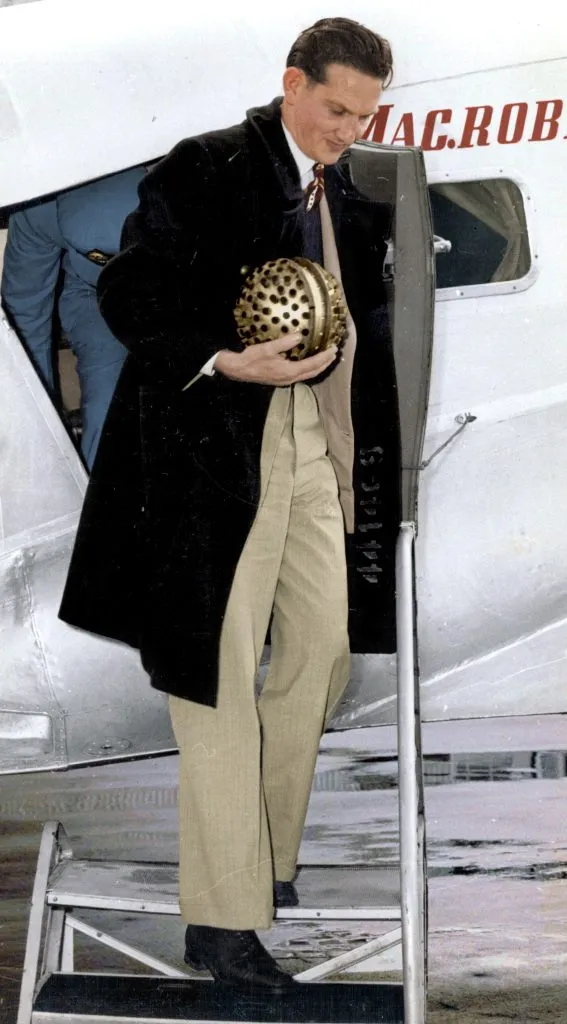
Encouraged, the Department of Civil Aviation (DCA) invited Orgill to conduct further tests aboard a DC-3 later that year. But crippling nerves forced him to abandon the first scheduled attempt. It took months before the department agreed to supply another aircraft.
Finally, on February 26, 1957, a second test flight went ahead at Melbourne’s Essendon Airport. Orgill was elated.
“The test…was above my wildest expectations,” he told People magazine. “The unit worked like a charm.”
Trade journal Aviation Week reported the same month that the device had passed both bench and flight tests “with satisfactory results.” Representatives from major flight-instrument manufacturers observed and were impressed.
But success brought frustration. As he told People, Orgill had spent years trying unsuccessfully to interest Australian and British companies. Hope came unexpectedly from America—specifically a foundation run by entertainer Bing Crosby, established to support independent inventors.
In November 1958, buoyed by friends, Orgill headed to the United States.
He made an immediate impression. A New York news brief from February 1959 described a young Australian who had “rolled structural and mechanical failure warnings into a lethal-looking aluminium ball” and was seeking US manufacturing partners.
What happened next is unclear—pieced together through clippings, letters, and fading memories. But it appears Orgill contacted the Bing Crosby Research Foundation, and through Crosby’s friendship with President John F. Kennedy, may even have received support at the highest political level.
In January 1960, The Sunday Times reported that the US Patent Office had agreed to issue a patent for Orgill’s invention, crediting a direct intervention by Kennedy. The article also quoted a letter from Orgill claiming significant interest from engineers at major American airlines—United, American, Pan Am, and TWA among them.
Yet his trusting nature became his downfall.
Returning to Perth in the early 1960s, he confided to friends that “the bastards in America” had stolen his invention. Close friend Leon Carboni later recalled a changed man—distraught, paranoid, and convinced he had been exploited.
About a month before his death, Orgill handed Carboni the original drawings. “You’re the only person I can trust,” he reportedly said. “Look after them for me.”
For decades, Orgill’s legacy remained obscure. In 1998, official black box pioneer Dr David Warren—who died in 2010 after a distinguished career—dismissed the suggestion that Orgill had produced the first true black box. He was unaware, he said, that Orgill had demonstrated a flight-recording unit at Essendon in 1957—the year before Warren’s prototype.
But when confronted with contemporary press reports, Warren conceded he may have met Orgill. A newly surfaced colourised photograph from the Australian National Archives shows Warren standing beside Orgill and his sphere shortly before that test flight.
Warren also asked to see any record of Orgill’s patents. At the time, none were known. But Australian researcher Peter Hobbins has since uncovered a US patent submitted on October 3, 1956 and granted in January 1963: Patent 3,074,065 — “Abnormal condition sequence indicating device.”
Warren rightly noted that basic flight recorders existed as early as the 1930s, and that his own device—developed at the Aeronautical Research Laboratories in Melbourne—was the first to combine comprehensive flight-data recording with cockpit audio.
The Warren system was eventually taken up by the British and licensed to Davall and Sons, and Australia became the first country to mandate black boxes.
But despite the murky history and competing claims, one fact remains beyond dispute:
Robert Henry Orgill was the first person in Australia to successfully flight-test a working crash-resistant flight-recording device.
His name deserves recognition.
This article first appeared in ASIAN AIRLINES & AEROSPACE written by the author.